I have made French toast for six people and I have made it for sixty, and the only time I got it badly wrong was the year I eyeballed it for a church breakfast and ran out of bread with eleven people still in line.
Jump to:
- Quick Answer: How Many Slices of French Toast Per Person?
- Jump to Calculator
- Quick Reference Chart
- Why French Toast Is Harder to Plan Than It Looks
- How Many Slices Per Person, Really
- How Much Bread to Buy
- The Custard Math
- Syrup, Butter, and the Cooking Line
- A Real Example
- Troubleshooting
- FAQ
- Final Thoughts
- Pin to Pinterest
Quick Answer: How Many Slices of French Toast Per Person?
Plan on 2 to 3 slices of French toast per adult and half that for kids 12 and under. For a standard brunch, 2½ slices per adult is the number that works. That's 28 slices for 10 guests or 55 slices for 20 guests, with a 10% safety buffer already built in.
If French toast is one item on a big breakfast spread with eggs and bacon, drop to 2 slices per adult. If it's the main event and there's not much else on the table, go up to 3.
The calculator below does the rest — loaves to buy, eggs, milk, syrup, butter, and how many pans or griddle rounds it actually takes.
Jump to Calculator
FRENCH TOAST CALCULATOR
Exact slices, loaves, eggs and milk for any crowd — plus how many griddle rounds it actually takes.
| Who | Slices | Notes |
|---|
| Guests | Big spread (2 ea) | Standard brunch (2½ ea) | Main event (3 ea) |
|---|---|---|---|
| 10 | 22 slices | 28 slices | 33 slices |
| 20 | 44 slices | 55 slices | 66 slices |
| 25 | 55 slices | 69 slices | 83 slices |
| 30 | 66 slices | 83 slices | 99 slices |
| 50 | 110 slices | 138 slices | 165 slices |
| 75 | 165 slices | 207 slices | 248 slices |
| 100 | 220 slices | 275 slices | 330 slices |
Quick Reference Chart
| Guests | Big spread (2 ea) | Standard brunch (2½ ea) | Main event (3 ea) |
|---|---|---|---|
| 10 | 22 slices | 28 slices | 33 slices |
| 20 | 44 slices | 55 slices | 66 slices |
| 25 | 55 slices | 69 slices | 83 slices |
| 30 | 66 slices | 83 slices | 99 slices |
| 50 | 110 slices | 138 slices | 165 slices |
| 75 | 165 slices | 207 slices | 248 slices |
| 100 | 220 slices | 275 slices | 330 slices |
These are adult portions with the 10% buffer included. Kids 12 and under count as half an adult.
Why French Toast Is Harder to Plan Than It Looks
Here's the thing about French toast. Every other breakfast food scales in a straight line. Twice the people, twice the pancakes. Done.
French toast has three moving parts that all scale differently, and they don't line up.
There's the bread, which comes in loaves, not slices — and loaves are wildly inconsistent. There's the custard, which depends on how much bread weighs, not how many pieces you have. And there's the cooking, which is the part that quietly ruins breakfasts, because a skillet that handles four slices does not handle seventy-five.
Miss any one of those and you're standing at the stove at 10:40 while everyone else eats.
How Many Slices Per Person, Really
Ellen's Kitchen, a long-running crowd-cooking resource, plans breakfast for 100 at 2 slices of French toast per person and about 12 pounds of bread. That works out to just under an ounce of bread per slice — which lines up closely with what a standard sandwich slice actually weighs.
Recipe developers land a little higher, usually 2 to 3 slices, because they're picturing a brunch where French toast is the star rather than one tray on a long buffet.
Both are right. They're describing different meals. So:
- Big breakfast spread — 2 slices per adult. There are eggs, ham, potatoes and fruit on the table too. Same logic as any buffet, where each dish carries less of the load.
- Standard brunch — 2½ slices per adult. French toast plus a couple of sides. This is the setting most people are actually in.
- Main event — 3 slices per adult. French toast, coffee, maybe fruit. Nothing else competing.
For a table full of teenagers or especially hungry eaters, I'd bump the estimate up by about half a slice per person.
Kids
Kids 12 and under eat half an adult portion. That's the standard across every calculator on this site, and French toast is one of the places it holds up cleanly — a kid eating one slice against an adult's two is exactly half.
The half-portion rule is about averages, not any particular child. You will have a seven-year-old who eats four slices. You will also have a nine-year-old who eats a corner and asks for cereal. Across a group it evens out.
How Much Bread to Buy
This is where most French toast planning falls apart, and it's not your fault. Loaves are not standardized.
A standard sandwich loaf runs 16 to 24 slices depending on the brand. Thick-cut brioche and Texas toast come in around 12 to 18 — a 17.6-ounce brioche loaf lists 7 servings of 2 slices on the nutrition panel, so 14 slices. And a bakery loaf you slice yourself gives you maybe 10 at a proper ¾ to 1-inch thickness.
| Bread | Slices per loaf | Usable for French toast | Weight per slice |
|---|---|---|---|
| Standard sandwich | 20 | 18 | 1 oz |
| Thick-cut brioche or Texas toast | 14 | 12 | 1¼ oz |
| Bakery loaf you slice yourself | 10 | 8 | 1½ oz |
That "usable" column is the part nobody accounts for, and the calculator has the two end slices already taken out of every loaf. Heels are mostly crust and they soak unevenly, so a lot of people set them aside. You can absolutely cook them — some folks like the chew — but leaving them out of the count keeps you from coming up two slices short, which is the error that actually costs you.
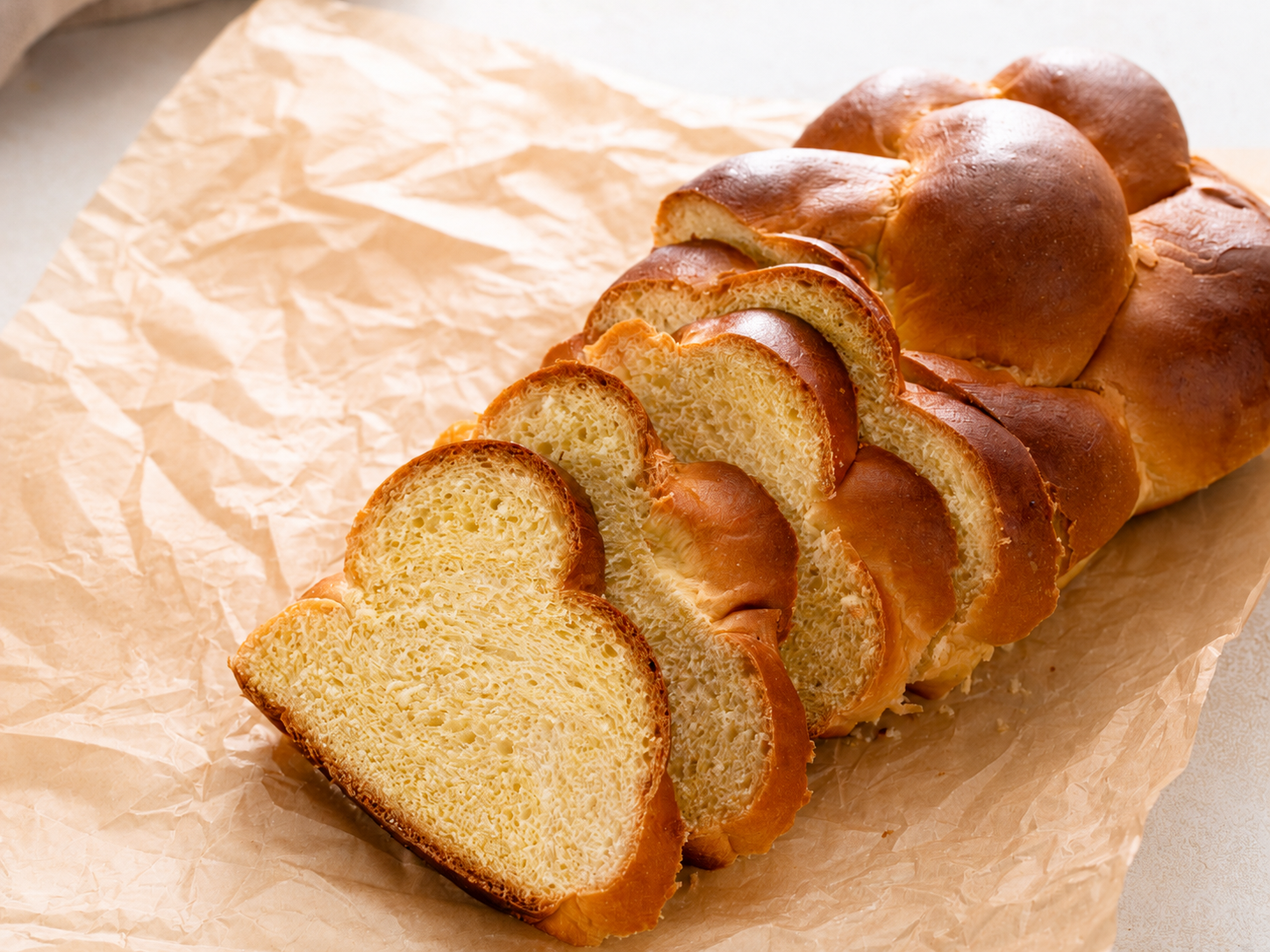
So for 20 guests at a standard brunch — 55 slices — you need 4 loaves of standard sandwich bread, 5 loaves of thick-cut brioche, or 7 bakery loaves. Same number of slices, very different shopping trip.
One more thing, and it matters more than the brand: buy the bread a day or two ahead. Dry bread drinks the custard; very fresh, soft bread is more likely to turn mushy or fall apart in the pan. If it still feels soft the night before, slice it and leave the pieces uncovered on a rack for a few hours. That one step separates good French toast from soggy French toast, and it costs nothing.
The Custard Math
I went looking for a clean egg-to-milk ratio and found chaos. Recipes range from 3 eggs to 10 eggs for the same eight slices.
The problem is that recipes count slices, and slices aren't a unit of anything. A slice of sandwich bread and a 1½-inch slab of challah are both "one slice" and one weighs half as much as the other.
Anchoring to weight at least makes the numbers comparable. For this calculator I use:
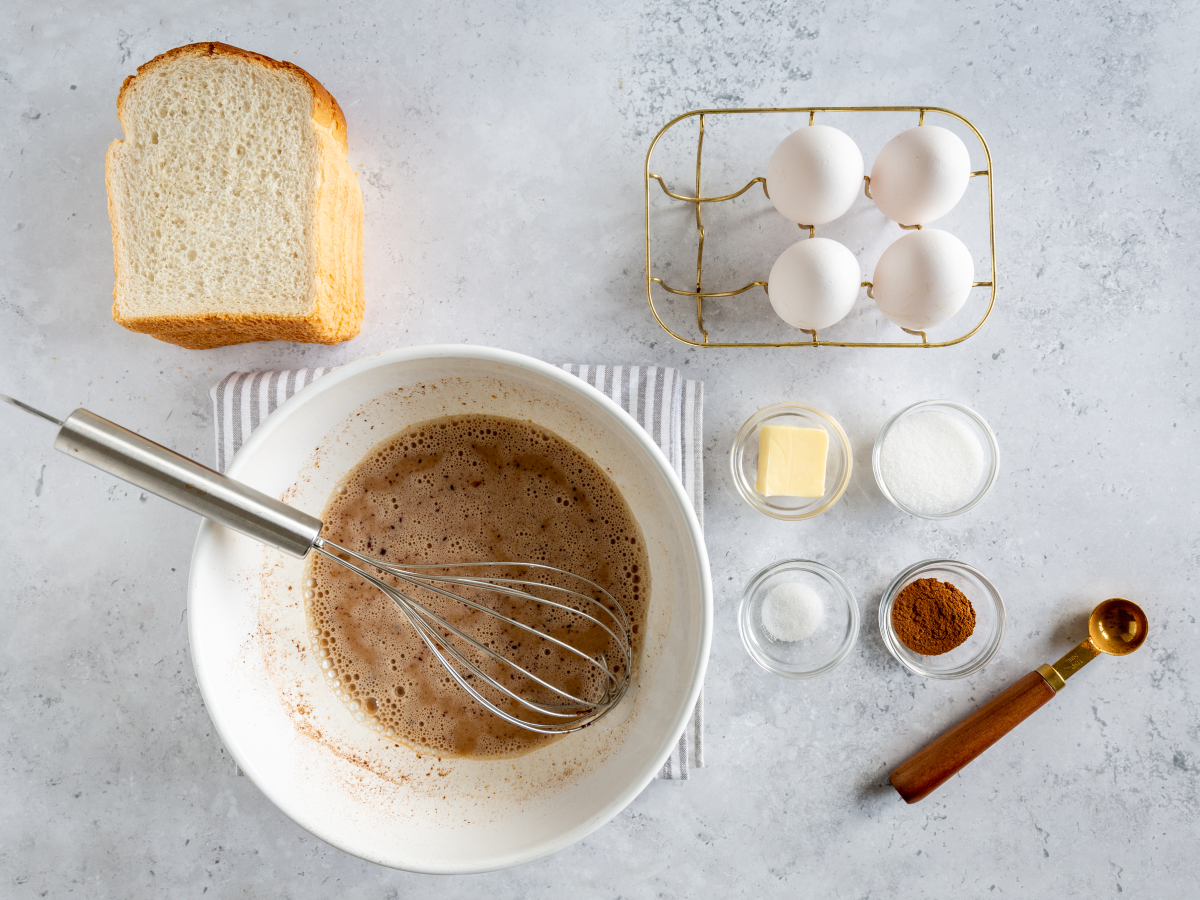
0.4 large eggs and 2 tablespoons of dairy per ounce of bread.
That's roughly 1 egg per 2½ ounces of bread, with about 5 tablespoons of milk per egg.
This is a planning ratio, not a law. Published recipes vary a lot — King Arthur's brioche French toast works out to about a third of an egg per slice, while Food Network's uses closer to two-thirds for the same thick-cut bread. My number sits between them on purpose. It's the middle of the road, which is where you want to be when you're buying groceries for thirty people rather than perfecting one pan.
Per slice it works out to:
| Bread | Eggs per slice | Dairy per slice |
|---|---|---|
| Standard sandwich (1 oz) | 0.4 | 2 Tbsp |
| Thick-cut (1¼ oz) | 0.5 | 2½ Tbsp |
| Bakery slice (1½ oz) | 0.6 | 3 Tbsp |
The easy version to remember: one egg for every two thick-cut slices.
Dairy amounts in the calculator round up to the nearest quarter cup, because nobody measures 1⅞ cups at 7am.
A note on overnight casseroles
These numbers are for dipped French toast — stovetop, griddle, or dipped slices finished on a sheet pan. The custard is the same across all three, because the bread only sits in it for a few seconds either way.
Overnight casseroles are a different animal, and I'm not going to pretend otherwise. Bread that soaks for eight hours absorbs far more, and casserole recipes are built for that. Food Network's overnight version uses a 16-ounce challah loaf with 12 eggs and 3 cups of dairy, which is nearly double the eggs my ratio calls for. Don't use this calculator's custard numbers for an overnight bake. I'd rather send you elsewhere than hand you a confident wrong answer, and I'll build a proper casserole calculator once I've tested it at that ratio.
Whole milk or half-and-half gives the richest result. Lower-fat milk still works — the eggs are what set the custard — it just won't be as rich.
Syrup, Butter, and the Cooking Line
Syrup: 0.7 ounces per slice, which lands near 1¾ ounces per person at a standard brunch. That matches both the foodservice single-serve portion cup and the 1-to-2-gallons-per-100-people figure crowd cooks use. If you're buying 12-ounce bottles, 30 people works out to about 5 bottles.
Butter: plan on ¼ to ½ tablespoon per slice for cooking. A skillet needs buttering every batch; a big griddle gets buttered once per round and lands at the low end. That's cooking butter only — table butter is extra.
Cooking capacity is the number that actually decides whether breakfast works. A large electric griddle handles about 8 slices at a time; a half sheet pan fits around 12 dipped slices. Both of those are working estimates from my own kitchen rather than published figures, so adjust them to your equipment.
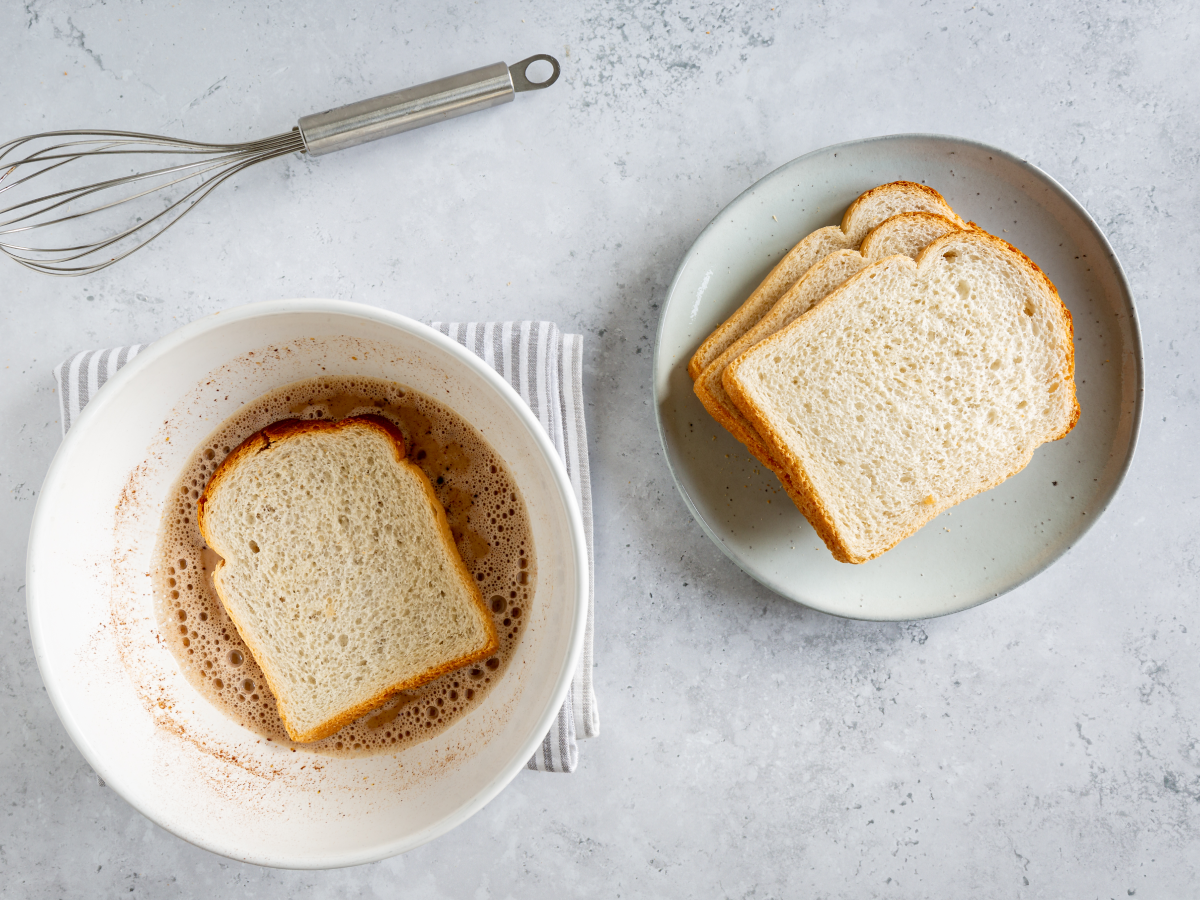
Do that division before the morning of. Seventy-five slices on a griddle is ten rounds. At four minutes a round, that's forty minutes of you standing there while your coffee goes cold. Dipped slices on a sheet pan run about 12 at a time, which is why the calculator asks which method you're using.
If you're planning a bigger gathering, the full party food guide and the party planning equipment list will save you a second trip to the store.
A Real Example
Christmas morning. 24 adults and 6 kids, thick-cut brioche, cooked on the griddle, French toast as part of a standard brunch.
- 24 adults × 2.5 slices = 60 slices
- 6 kids × 1.25 slices = 7.5 slices
- 60 + 7.5 = 67.5 slices
- 67.5 × 1.10 buffer = 75 slices
From there:
- 7 loaves of brioche (75 ÷ 12 usable slices per loaf)
- 38 large eggs (75 slices × 1¼ oz = 93.75 oz of bread, × 0.4)
- 11¾ cups of milk or half-and-half
- 53 oz of syrup — about 5 bottles (75 slices × 0.7 oz)
- 19–38 tablespoons of butter — up to 5 sticks
- 10 griddle rounds
Ten rounds is the number I'd want to know the night before. That's when you decide to dip onto sheet pans and bake instead, or to recruit somebody to work a second griddle.
Troubleshooting
"The calculator says 18 loaves." You picked the bakery loaf at a large guest count. Hand-sliced loaves only yield 8 usable slices, so the loaf count climbs fast. Switch to thick-cut brioche and the same order drops by more than half. Bakery bread is wonderful for twelve people and a logistics problem for fifty.
"Ten griddle rounds" sounds impossible. It is, if you're doing it alone at 9am. Switch the method toggle to sheet pan and the same order becomes a smaller number of oven batches. Or run two griddles. Either way, you want to know this the night before, not the morning of.
The middle is soggy. Bread was too fresh, or it sat in the custard too long. Dry the bread out first, and dip rather than soak: a few seconds a side for sandwich bread, a bit longer for thick-cut.
You ran out of custard halfway. Some custard always stays behind in the dish. That's normal and it's why the buffer exists. Mix in two batches rather than one giant bowl, so you're not committing all your eggs to a pan that's holding more than it needs.
It's cold by the time everyone sits down. Hold finished slices on a wire rack over a sheet pan in a 200°F oven. A rack, not a plate — stacked slices steam themselves soft.
FAQ
How many slices of French toast per person? Two to three slices per adult, and half that for kids 12 and under. Use 2 when it's part of a big spread, 2½ for a standard brunch, and 3 when French toast is the main dish.
How much bread do I need for 20 people? About 55 slices for a standard brunch. That's 4 loaves of standard sandwich bread, 5 loaves of thick-cut brioche, or 7 bakery loaves.
How many eggs for 12 slices of French toast? 5 eggs and 1½ cups of dairy for standard sandwich bread. For thick-cut slices, 6 eggs and 2 cups. For big bakery slices, 8 eggs and 2¼ cups. These are rounded up to practical measuring amounts — the thick-cut figure is 1⅞ cups on the nose.
What's the best bread for French toast? Thick-cut brioche or challah, a day or two stale. Sturdy enough to hold together, open enough to soak. For a crowd, thick-cut brioche also gives you the most usable slices per loaf without hand-slicing.
Can I make French toast ahead? Yes. Cook it fully, cool it on a rack, refrigerate, and reheat on a sheet pan at 350°F for about 10 minutes. It holds up better than you'd think. An overnight casserole is the other route, but the custard math is different — don't use these numbers for it.
Do I need to add a buffer? The calculator adds 10% by default and I'd leave it on. Leftover French toast reheats fine in a toaster. Running out does not have a fix.
Final Thoughts
French toast for a crowd is not a difficult recipe. It's a logistics problem wearing a recipe costume.
Get the bread count right, buy it early enough to go stale, anchor your custard to weight instead of slice count, and know your cooking rounds before the morning of. That's the whole thing.
If you're building out the rest of the menu, pancakes per person is the natural companion when you want two griddle options, and dinner rolls per person runs on the same bread-yield logic. For drinks, check how many drinks per person and how much ice per person — running out of ice is the other classic hosting mistake. And if your crowd is bigger than 25, how much food for 25 to 100 guests covers the whole table.
Now go buy your bread a day or two early.
Pin to Pinterest