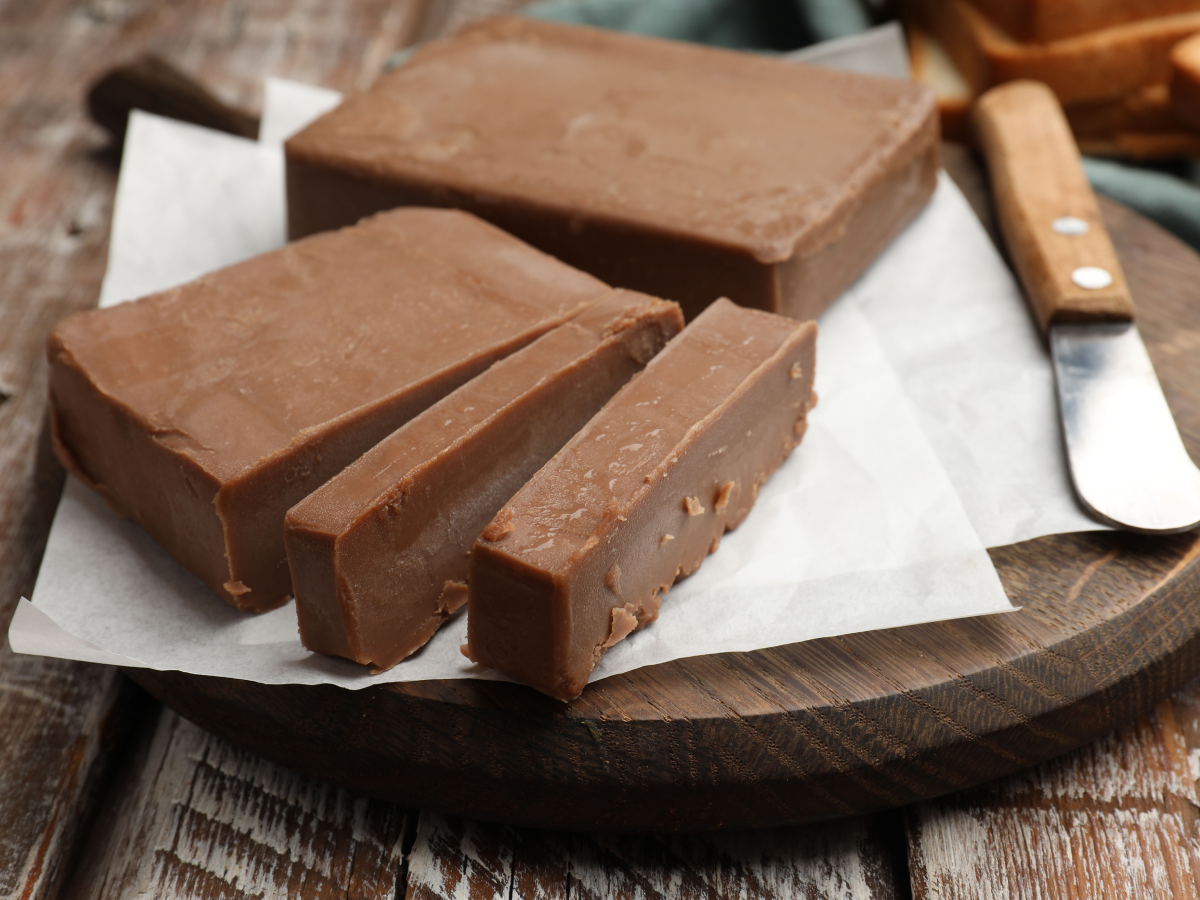
Fudge looks like the easiest dessert on the table to plan. Then you realize fudge recipes don't always say how they cut the pan. Here's the short version: plan on 2 pieces of fudge per guest when it's one of several desserts, and 3 per guest when fudge is the star.
Jump to:
Quick Answer: Fudge Per Person
- Fudge is one of several desserts: 2 pieces per guest
- Fudge is the star of the table: 3 pieces per guest
- One batch of my fudge in a 9×13 pan, cut 7 × 12: 84 pieces
- One batch covers: 42 guests at 2 pieces, 28 guests at 3 pieces, or 7 gift boxes of 12
For 50 guests at 2 pieces each, that's 100 pieces, or 2 batches. Add the 10% safety buffer and it's 110 pieces. Still 2 batches.
Planning the whole spread? My ultimate party food planning guide has portion charts for everything else on the table.
Fudge Per Person Calculator
Enter your dessert table guests, your gift boxes, or both. The calculator adds them together, rounds up to whole batches, and gives you a shopping list with the exact bags, jars, and cans to buy.
FUDGE CALCULATOR
Get exact batches, pieces, and a full shopping list for a dessert table or a stack of gift boxes. Built on my Creamy Old-Fashioned Fudge, cut 7 × 12.
| What | Amount | Notes |
|---|
| Guests | Mixed table (2 pp) | Fudge is the star (3 pp) |
|---|---|---|
| 10 | 20 pieces · 1 batch | 30 pieces · 1 batch |
| 20 | 40 pieces · 1 batch | 60 pieces · 1 batch |
| 25 | 50 pieces · 1 batch | 75 pieces · 1 batch |
| 30 | 60 pieces · 1 batch | 90 pieces · 2 batches |
| 50 | 100 pieces · 2 batches | 150 pieces · 2 batches |
| 75 | 150 pieces · 2 batches | 225 pieces · 3 batches |
| 100 | 200 pieces · 3 batches | 300 pieces · 4 batches |
Every number in this calculator comes from one recipe: my Creamy Old-Fashioned Fudge, made in a 9×13 pan and cut 7 × 12. If you're using a different recipe or a different pan, the pieces-per-guest numbers are still a good starting point. The batch math won't match.
Fudge Per Person Chart
| Guests | Mixed table (2 per guest) | Fudge is the star (3 per guest) |
|---|---|---|
| 10 | 20 pieces · 1 batch | 30 pieces · 1 batch |
| 20 | 40 pieces · 1 batch | 60 pieces · 1 batch |
| 25 | 50 pieces · 1 batch | 75 pieces · 1 batch |
| 30 | 60 pieces · 1 batch | 90 pieces · 2 batches |
| 50 | 100 pieces · 2 batches | 150 pieces · 2 batches |
| 75 | 150 pieces · 2 batches | 225 pieces · 3 batches |
| 100 | 200 pieces · 3 batches | 300 pieces · 4 batches |
One batch = 84 pieces (a 9×13 pan cut 7 × 12). Chart shows pieces before the 10% safety buffer. The calculator adds the buffer for you.
Why 2 or 3 pieces?
Here's the thing: fudge is rich. Nobody eats it by the handful.
These are my planning tiers, and I checked them against two businesses that sell fudge. Fudgery's buying guide says to plan 2 small pieces per person, then adjust for the other desserts. A wedding fudge vendor's package listing builds its standard table package around 3 pieces per guest, with a bigger 5-piece package for couples who want more.
So I use 2 when fudge shares the table with cookies, brownies, and pie, and 3 when fudge is the thing people came for.
If fudge is sharing the table, the brownies per person calculator and the dessert bars per person guide will help you balance everything else.
Don't use candy buffet math for fudge
You'll see "8 ounces of candy per guest" all over the internet. Candy retailers use that rule — Candy Favorites is one — and it's meant for a whole candy buffet. Your Wedding Company pairs it with 5 to 10 different kinds of candy on the table.
Use it for one tray of fudge and you'll make way more than anyone can eat. Fudge gets counted in pieces, not ounces.
How Many Pieces of Fudge in a 9×13 Pan?
84 pieces, cut 7 × 12. And I learned that one the honest way.
On paper, 9 × 13 inches of fudge cut into 1-inch squares would make 117 pieces. Nine times thirteen. Easy. Then I actually cut a batch and counted. I got 84.
Here's what happened. My pan is sold as a 9×13, but it measures 8¼ × 12½ across the flat bottom, and the corners are rounded. With 8¼ inches to work with, 1-inch squares leave you only a quarter inch of wiggle room across the short side. If your squares come out even a hair wider than 1 1/32 inches, you lose an entire strip of 12 pieces.
Nobody can see 1/32 of an inch with a knife in their hand. So forget inches. Cut by count:
- Lift the whole slab out of the pan by the foil.
- Cut the short side into 7 strips.
- Cut the long side into 12 strips.
That's 84 pieces, every time, no ruler required.
Grab a ruler and measure the flat bottom of your own pan. If you cut a different grid, count your pieces and divide your total by that number instead of 84.
Fudge for Gift Boxes and Tins
This is where fudge math gets real. Neighbors, teachers, coworkers, the bus driver. Here's how far one batch goes:
| Pieces per box | Full boxes per batch | Left over |
|---|---|---|
| 6 | 14 | 0 |
| 12 | 7 | 0 |
| 24 | 3 | 12 |
Say you're making 14 boxes of 12. That's 168 pieces, which is exactly 2 batches with 0 extra. Zero. Not one piece for the cook. Trust me on this: if you want a taste, add one box to your count.
The calculator counts gift boxes exactly and applies the 10% buffer to dessert table guests only. You know how many boxes you're filling. You don't always know who's going to show up at the party.
Packing tips:
- Put wax paper between each layer of fudge so the pieces don't stick together.
- Don't pack fudge in the same tin as caramels, hard candies, mints, or toffee. Those candies absorb moisture, and fudge loses it. Wrap each kind separately if they're going in the same gift.
Building a full cookie tin? The cookie exchange calculator and the sugar cookie calculator figure out the rest of the box.
Your Fudge Shopping List
| Ingredient | Per batch | What to buy |
|---|---|---|
| Granulated sugar | 4½ cups | A 4 lb bag covers 2 batches, just barely |
| Butter | 1 stick | 1 stick per batch |
| Evaporated milk | 13 oz (368.5 g), weighed | A 12 fl oz can pours 12.8 oz, just short of one batch. Buy 2 cans for 1 batch, 3 cans for 2 batches |
| Marshmallow creme | 7 oz | One 7 oz jar per batch |
| Semi-sweet chocolate chips | 24 oz | Two 12 oz bags per batch (Nestlé preferred) |
| Vanilla extract | 1 tsp | 1 teaspoon per batch |
A few store-shelf traps worth knowing before you go:
Sugar. Domino labels its 4 lb bag at about 9 cups. That's exactly 2 batches. By weight, 2 batches at 200 grams per cup use 1,800 grams, and a 4 lb bag holds 1,814.4 grams. That leaves you 14.4 grams to spare. Don't spill. And skip the 3.5 lb tub if you're making 2 batches. It only covers 1.
Marshmallow creme. Jet-Puffed comes in a 7 oz jar and a 13 oz jar, usually right next to each other. The 13 oz jar looks like it covers 2 batches. It doesn't. You'd need 14 oz. One 13 oz jar won't cover 2 batches.
Chocolate chips. Two 12 oz bags per batch. If you're making 3 batches, Costco's 72 oz bag is exactly 3 batches.
Here's what 3 batches looks like at the store:
- 2 bags of sugar (4 lb each), for 13.5 cups
- 3 sticks of butter
- 4 cans of evaporated milk (12 fl oz each)
- 3 jars of marshmallow creme (7 oz each)
- 6 bags of chocolate chips (12 oz each), or 1 bag of 72 oz
- 3 teaspoon vanilla extract
Why I Weigh the Evaporated Milk
My recipe card says 13 oz evaporated milk, must be exact. I mean 13 ounces by weight. And when I actually weighed a can, it surprised me.
A standard can of evaporated milk is labeled in fluid ounces. Carnation's says 12 fl oz right on the front. I poured one out and weighed just the milk: 12.8 oz (362.9 grams). That's 0.2 oz short of one batch.
So one can isn't quite enough. Each batch takes a full can plus a little from a second one. The good news is the leftover carries into your next batch, so 2 batches take 3 cans, not 4. The calculator does that math for you.
It gets more confusing because the sweetened condensed milk on the same shelf is labeled by weight. I weighed two 14 oz cans from two different brands. By weight, 14 oz is 396.9 grams, and my scale read 396 grams and 397 grams. Same aisle, same can shape, different kind of ounce.
That's why a measuring cup doesn't work here. Measure 13 fluid ounces and you'll pour more than a full can, and a full can already weighs 12.8 oz.
- 13 oz by weight, what my recipe needs: 368.5 grams
- 13 fluid ounces, by USDA's figure of 31.5 grams per fluid ounce: 409.5 grams
That's 41 grams of extra liquid, more than 11% over what the recipe calls for. If you're going by the 4 to 6 minute boil time, that extra water may still be in the pot when time's up. That's a likely reason fudge won't set. A candy thermometer is your safety net, because the mixture can't reach its target temperature until that water cooks off.
So set a bowl on your kitchen scale, zero it out, and empty the first can into it. Then top it off from the second can until the scale reads 368.5 grams.
Make It in Batches, Not a Doubled Pot
I know. Doubling sounds faster. Don't do it with candy.
Land O'Lakes doesn't recommend doubling candy recipes, because the extra ingredients may keep the mixture from cooking properly. Make each batch start to finish, then start the next one.
What actually saves time:
- Line every pan with foil before you start the first batch.
- Measure out each batch's ingredients ahead of time so you're not weighing milk while sugar boils.
- Plan your day around setting time. Each batch needs about 4 hours at room temperature before you cut it.
Troubleshooting
My fudge didn't set
- You measured the milk by volume. Go back one section. Weigh it.
- It didn't get hot enough. The 4 to 6 minute boil is a guide. The real target is the temperature: 234–236°F in my kitchen at [ELEVATION] feet, and [SEA-LEVEL LOW]–[SEA-LEVEL HIGH]°F at sea level. See the temperature section below.
- Your thermometer was reading wrong. Stand it upright in the pot with the bulb fully covered, but not touching the bottom. Keep it about ½ inch off the bottom of the pan.
My fudge is grainy
- Sugar crystals got in. When you pour, don't scrape the last of the mixture out of the pot. Stray sugar crystals can sneak in that way.
- The good news: Recipes with marshmallow creme, like mine, make fudge that's less grainy to begin with.
Adjusting the temperature for where you live
<!-- [FILL BEFORE PUBLISHING — ELEV = Summer's elevation in feet, or better, B = her thermometer's reading in boiling water. Sea-level range = 234 + (212 - B) to 236 + (212 - B). Without B: 234 + 2 x (ELEV / 1000) to 236 + 2 x (ELEV / 1000).] -->
I live in the Utah mountains, and that's where this recipe was tested. The 234–236°F on my recipe card is what works in my kitchen at [ELEVATION] feet.
Water boils at a lower temperature the higher up you live, and candy temperatures shift with it. Colorado State University Extension's rule is 2°F for every 1,000 feet of elevation. So if you live lower than I do, your fudge needs to cook hotter than mine.
- At sea level: cook to [SEA-LEVEL LOW]–[SEA-LEVEL HIGH]°F.
- Anywhere above sea level: start from the sea-level range and subtract 2°F for every 1,000 feet of elevation.
The easiest way to get your exact number: bring a pot of water to a rolling boil and check your thermometer. Take the difference between that reading and 212°F, and subtract it from the sea-level range. That one test adjusts for your altitude and your thermometer at the same time.
I came up short on pieces
- Check your grid. Cut 7 × 12, not "1-inch squares." A slightly-too-wide square costs you a strip of 12.
- Measure your pan. If yours is bigger or smaller across the flat bottom, count your actual pieces and use that number.
- Leave the buffer on. It's on by default in the calculator for a reason.
FAQ
How much fudge do I need for 25 guests?
At 2 pieces per guest, you need 50 pieces, which is 1 batch. At 3 pieces per guest, you need 75 pieces, still 1 batch. With the 10% buffer, that's 55 pieces or 83 pieces, and 1 batch covers either one.
How much fudge do I need for 50 guests?
At 2 pieces per guest, you need 100 pieces, which is 2 batches. At 3 pieces per guest, you need 150 pieces, also 2 batches. With the 10% buffer, that's 110 pieces or 165 pieces, still 2 batches.
How much fudge do I need for 100 guests?
At 2 pieces per guest, you need 200 pieces, which is 3 batches. At 3 pieces per guest, you need 300 pieces, which is 4 batches. With the 10% buffer, that's 220 pieces (3 batches) or 330 pieces (4 batches).
How many pieces of fudge are in a 9×13 pan?
84 pieces when you cut my recipe 7 × 12. On paper, 9 × 13 inches of fudge would make 117 one-inch squares, but my pan measures 8¼ × 12½ across the flat bottom, so the real count is lower. Measure your own pan.
How many gift boxes does one batch of fudge fill?
One batch fills 7 boxes of 12 exactly, 14 boxes of 6 exactly, or 3 boxes of 24 with 12 pieces left over.
Can I double a fudge recipe?
Don't. Make separate batches. Extra ingredients can keep candy from cooking properly, so the calculator always gives you a number of separate batches to make.
How far ahead can I make fudge?
Fudge keeps in the fridge for up to 2 weeks, or in the freezer for longer. Make it before the party week gets busy.
Can I use a 13 oz jar of marshmallow creme?
For 1 batch, yes, and you'll have 6 oz left over. For 2 batches, no. You need 14 oz, so buy two 7 oz jars instead.
Final Thoughts
Fudge math comes down to a few numbers. 2 pieces per guest on a mixed table, 3 when fudge is the star. One batch is 84 pieces cut 7 × 12. That's 7 gift boxes of 12. Weigh the milk, make separate batches, and cut by count instead of by inches.
Once the fudge is handled, the rest of the table is easy. The dessert charcuterie board guide and the cookies per person guide cover the sweets.
For a winter party, the hot chocolate calculator handles the drinks, and the wedding dessert table portions guide covers the big events.