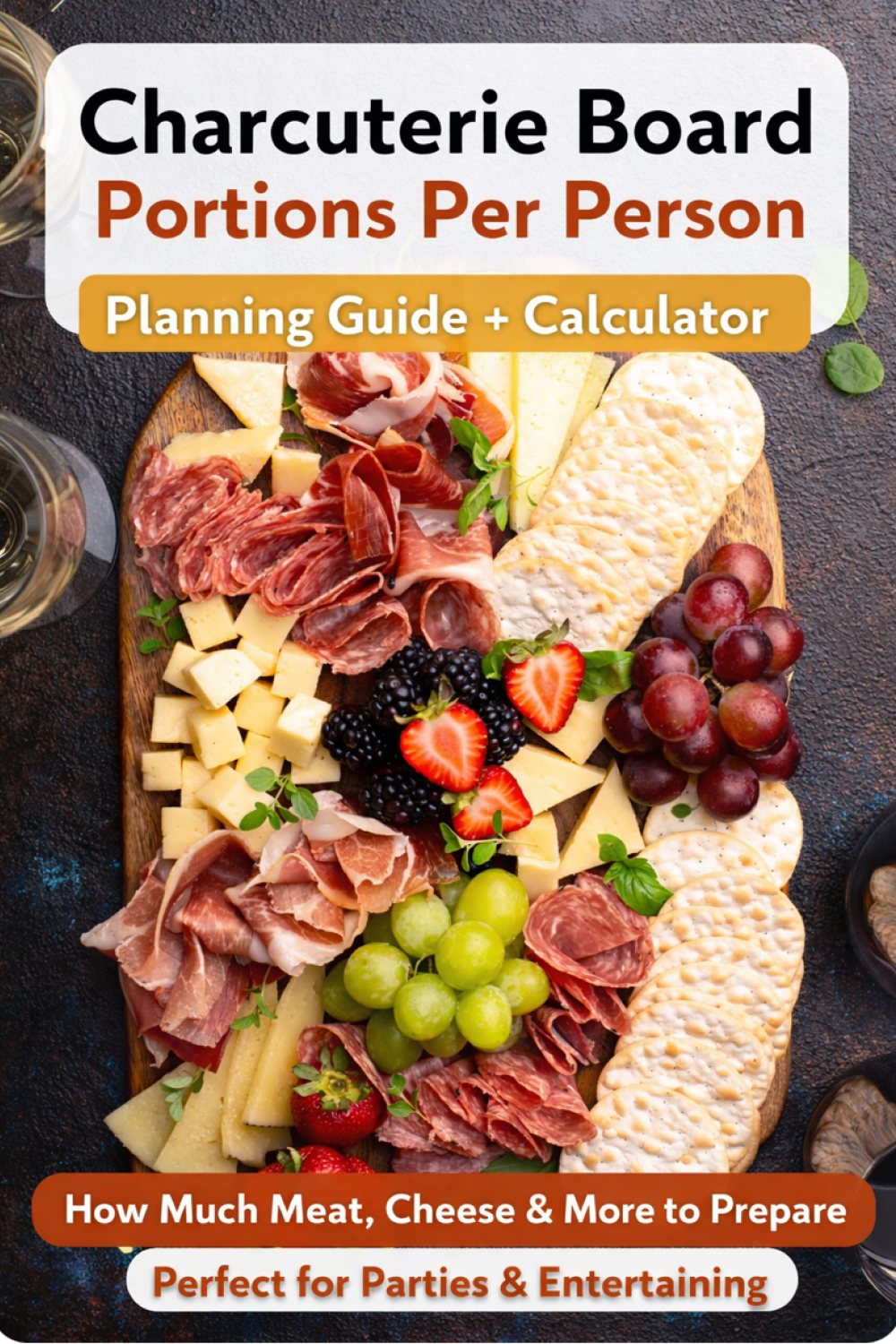
You're hosting in a few hours and trying to figure out how much charcuterie to put out. The grocery store run is happening either way — the question is how much salami, how many cheeses, how many crackers. Standing in front of the deli counter is the worst place to do this math, so let's do it now.
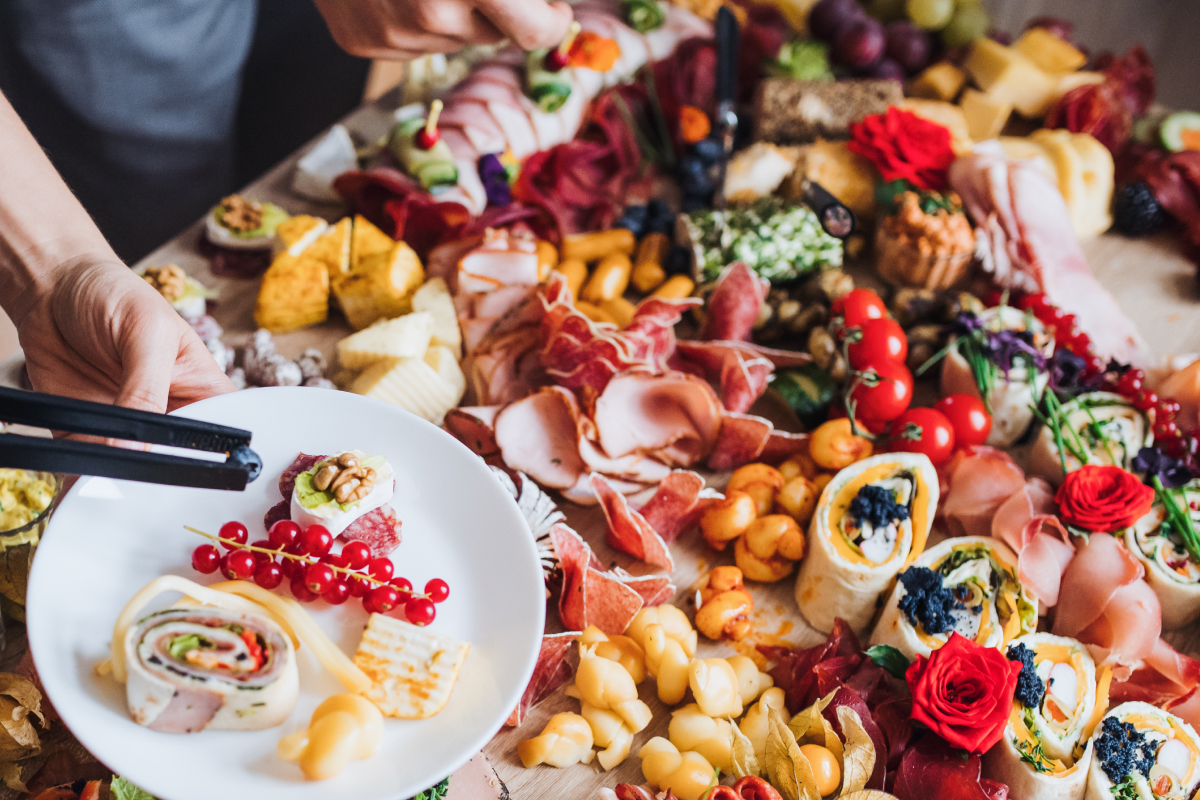
Here's the short version: plan 2-3 ounces of meat and 2-3 ounces of cheese per person when charcuterie is the appetizer. Double both if the board is the actual meal. Then add crackers, fruit, nuts, and a couple of small extras. For 20 guests as an appetizer, that's about 2½–3 pounds of meat, 2½–3 pounds of cheese, 80–120 crackers, and a few cups of accompaniments.
This guide walks you through the exact portion math, the calculator that handles the variables for you, the meat-cheese-cracker breakdown by category, and the small things that change the numbers — whether your guests are pre-meal grazers or settling in for a charcuterie-as-dinner kind of night.
For everything else on the party table, the ultimate party food planning guide covers full meals, and the how much food for 25–100 guests guide handles bigger spreads.
Jump to:
Quick Answer
For most gatherings, plan 2-3 ounces of cured meat and 2-3 ounces of cheese per person, plus 4-6 crackers, ¼ cup of fruit, and 1-2 tablespoons of accompaniments like olives, nuts, or honey. That's about 4-6 ounces of charcuterie food total per person when the board is an appetizer.
For 20 guests as an appetizer, that works out to:
- 2½–3 pounds of cured meat (combined across 2-3 varieties)
- 2½–3 pounds of cheese (combined across 3 varieties)
- 80-120 crackers and bread pieces
- 5 cups of fresh fruit
- 2 cups of mixed accompaniments (olives, nuts, jam, honey)
But here's the thing — those numbers change a lot based on what the board is actually doing at the party. A board that's the only food at a 2-hour wine night needs different math than a board sitting alongside a full dinner spread. A grazing table that runs all afternoon needs even more. Time of day matters. Whether the crowd is hungry or already-fed matters. Whether you're hosting bigger appetites matters.
The calculator below handles all the variables. Skip down to your event type for the specific math, or use the chart further down for quick reference.
Charcuterie Board Calculator
Don’t guess your board—use this calculator to get the right balance of meats, cheeses, and extras so everything looks full without overbuying.
CHARCUTERIE BOARD CALCULATOR
Get exact meat, cheese, cracker, fruit, and extras amounts — for appetizer spreads, grazing boards, and charcuterie as a full meal.
| Category | Amount | Notes |
|---|
| Guests | Light Spread (3–4 oz) | Appetizer Board (4–6 oz) | Grazing Board (6–8 oz) | Main Meal (8–10 oz) |
|---|---|---|---|---|
| 10 | 2–2½ lbs | 3–4 lbs | 4½–5½ lbs | 5½–7 lbs |
| 20 | 4½–5½ lbs | 6¼–8 lbs | 9–11 lbs | 11¼–14 lbs |
| 30 | 6½–8¼ lbs | 9½–12 lbs | 13½–16½ lbs | 17–21 lbs |
| 50 | 11–14 lbs | 15½–20 lbs | 22½–27½ lbs | 28–35 lbs |
| 75 | 16½–21 lbs | 23½–31 lbs | 34–41 lbs | 42–52 lbs |
| 100 | 22–27½ lbs | 31¼–41¼ lbs | 45–55 lbs | 56–69 lbs |
Which Charcuterie Setup for Which Event?
Find your event type and get the portion math that fits.
Appetizer Board (Pre-Dinner Grazing)
Portion: 2-3 oz meat + 2-3 oz cheese per person, plus 4-6 crackers and a couple tablespoons of accompaniments.
Best for: Holiday dinners where the board is the pre-meal nibble, dinner parties where appetizers are happening before guests sit down, cocktail hour at events.
The catch: Guests will eat less charcuterie if they know a meal is coming. If you're serving dinner in an hour, lean toward 2 oz per person rather than 3. If you've told everyone "appetizers at 6, dinner at 8," lean toward 3.
Cocktail Hour
Portion: 3-4 oz meat + 3-4 oz cheese per person, plus 6-8 crackers and more substantial accompaniments.
Best for: Wine and cheese nights where the board is the food for the evening, cocktail parties where there's no follow-up meal, holiday cocktail hours that run 2-3 hours.
Pro tip: When wine and conversation are flowing, people graze longer than they realize. Buy 25% more than you think you need. Leftover salami freezes; leftover regret doesn't.
Charcuterie as the Meal
Portion: 4-6 oz meat + 4-6 oz cheese per person, plus 10-12 crackers, a salad, and bread. Maybe a soup if it's winter.
Best for: Casual dinner parties built around the board, "no real meal" nights at home, summer evenings where the board IS dinner.
The math difference: A meal-replacement board for 8 people needs roughly 2 pounds of meat and 2 pounds of cheese — almost double the appetizer amounts. Pair with a real bread (not just crackers), a green salad, and a dessert. Now it's a meal.
Grazing Table (Runs 2+ Hours)
Portion: Start with appetizer amounts, then add 25% per hour after the second hour.
Best for: Holiday open houses, baby showers, bridal showers, graduation parties — anywhere the board is set out for guests to nibble at over a long stretch.
The catch: Long events drain a board faster than short ones because guests come back multiple times. A 3-hour grazing event for 30 people needs about 25% more than the 2-hour version. A 4-hour event needs 50% more. Build in cushion or plan to refresh the board halfway through.
Kids Party or Mixed-Age Crowd
Portion: Adults get standard portions; kids (under 12) count as half a portion.
Best for: Family gatherings, birthday parties, anywhere the guest list spans ages.
Pro tip: Kids gravitate toward cheese, crackers, fruit, and nuts. Cured meats get eaten less by kids. If half your crowd is under 12, you can cut your meat amounts by 20-30% and bump up the cheese and fruit. Save money and reduce waste at the same time.
Heavy Eaters or Game Day Crowd
Portion: Standard amounts +25-50%.
Best for: Super Bowl parties, game day spreads, gatherings of "let's actually eat" crowds.
Real talk: Teenage boys, gym-bro crowds, and pre-game appetizers all need the bigger numbers. If you've got more than a few hearty eaters, just plan for the bigger portions across the board. People notice when they run out; they rarely complain about plenty.
Why Charcuterie Math Isn't One-Size-Fits-All
Most people think of charcuterie portions as one rule: "2-3 ounces per person, done." But that rule only works for one specific scenario (appetizer board, average appetites, 1-2 hour event). For everything else, the math shifts because charcuterie is actually doing three different jobs depending on the gathering.
Job 1: Appetizer. The board is filling time before the real meal. Guests take small portions because they know dinner is coming. Math: 2-3 oz meat and cheese per person. Total food per person: about 4-6 ounces.
Job 2: Main snacking food. The board is the food of the evening — wine night, cocktail hour, casual gathering. No follow-up meal. Guests linger and graze. Math: 3-4 oz meat and cheese per person, plus more crackers and accompaniments. Total food per person: 6-8 ounces.
Job 3: Replacement meal. The board is dinner. Guests need to leave satisfied, not just snacked. Math: 4-6 oz meat and cheese per person, plus bread, fruit, and a salad. Total food per person: 10-12 ounces.
Three different jobs, three different portion sizes. Doubling the portions for a meal-replacement board isn't excessive — it's the actual math that makes the board work as dinner.
There's a fourth variable nobody talks about: time. A 1-hour board feeds differently than a 4-hour board. Once guests have been grazing for two hours, they've usually circled back twice. By hour three, they've eaten more than the original portion math suggested. The standard advice is to add 15-25% per hour after the second hour, which sounds excessive until you realize how much salami can disappear over an afternoon.
The calculator below handles all of this — just tell it your event type, guest count, appetite level, and event length.
The 5 Charcuterie Categories (with Exact Amounts)
A balanced board comes from getting the right amount across five categories: meats, cheeses, crackers/bread, fresh items, and small extras. Here's how to plan each.
1. Cured Meats
Portion: 2-3 oz per person for appetizer boards, 4-6 oz per person for meal-style boards.
The variety rule: Plan 2-3 different meats for boards serving up to 12 guests, 3-4 meats for 12-30, and 4-5 meats for larger gatherings. More variety = more interest, but past 5 different meats it starts feeling cluttered.
The meat selection guide:
- One mild, sliced thin — prosciutto is the crowd favorite, mortadella works too. About 30-40% of your total meat.
- One spicy or seasoned — soppressata, hot calabrese salami, chorizo. About 30-40% of total meat.
- One robust or smoked — speck, capocollo, jamón serrano, smoked turkey if you want something lighter. The remaining 20-30%.
The hosting tip nobody mentions: Slice your prosciutto thin. Like, really thin. Have the deli counter slice it for you because home knives can't get it that thin without practice. Thinly sliced prosciutto goes about 50% further than thicker slices, and it actually tastes better — you get more aroma per bite.
For 20 guests at an appetizer board: 2½–3 pounds of meat total. Roughly 1 pound prosciutto, 1 pound salami, ½–1 pound of something with more body.
2. Cheese
Portion: 2-3 oz per person for appetizer boards, 4-6 oz per person for meal-style boards.
The 3-cheese rule: Almost every good board has at least three cheeses across these categories:
- One soft — brie, camembert, goat cheese, or fresh mozzarella. The crowd-pleaser cheese.
- One semi-firm — gouda, havarti, manchego, fontina. The pairs-with-everything cheese.
- One firm or strong — aged cheddar, parmesan, blue cheese, gruyère. The flavor anchor cheese.
For bigger gatherings (30+), add a fourth cheese for variety — usually another firm one in a different milk type (goat, sheep, cow). Cheese variety matters more than meat variety; people eat cheese in more configurations.
Cheese shopping math:
- For 10 guests: 1½–2 lbs cheese across 3 varieties (about 8 oz each)
- For 20 guests: 2½–3 lbs across 3-4 varieties
- For 50 guests: 6-8 lbs across 5-6 varieties
The hosting tip: Cut about half your cheese before guests arrive (especially the hard cheeses), and leave the rest in chunks with a knife. Pre-cut cheese disappears faster than chunks because it's easier to grab — which is what you want if your board has a long evening ahead of it. Chunks with knives slow down consumption and look more intentional.
3. Crackers and Bread
Portion: 4-6 pieces per person for appetizer, 8-10 pieces for cocktail hour, 10-12 for meal-style.
Crackers go faster than you'd think — they're the vehicle for everything else. The rule is one cracker or bread piece per slice of meat or cheese, minimum. Always buy more than you think you need; leftover crackers keep for weeks in their packaging.

The variety rule:
- One neutral cracker — water crackers, plain artisan crackers. Lets the meat and cheese flavors shine.
- One sturdy option — sliced baguette (slice it yourself, way cheaper than buying baguette chips), seeded crackers, or breadsticks.
- One flavored option — fig and olive crackers, herb crackers, or salt-and-pepper. Optional, but adds variety.
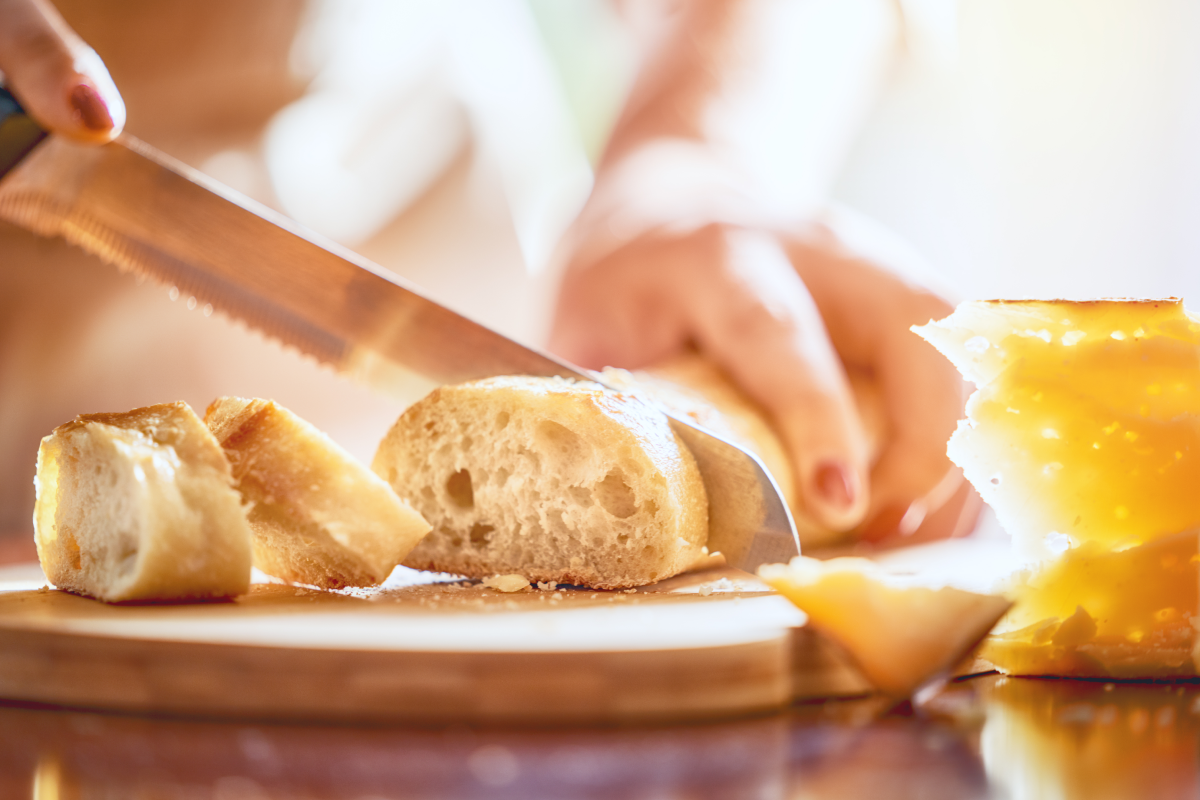
Budget tip: A $3 baguette sliced thin produces about 30-40 pieces — way more than a $7 box of artisan crackers gives you. Toast the slices for 5 minutes at 350°F if you want them crispier. This is the single biggest place to save money on a charcuterie spread without sacrificing quality.
4. Fresh Items (Fruit, Vegetables, Herbs)
Portion: ¼ cup per person for appetizer, ½ cup for cocktail hour or meal-style.
Fresh fruit and vegetables do two jobs: they balance the saltiness of cured meats and cheeses, and they fill in visual gaps on the board (which is why the board looks "full" even when half the meat is gone).
The best fresh items by season:
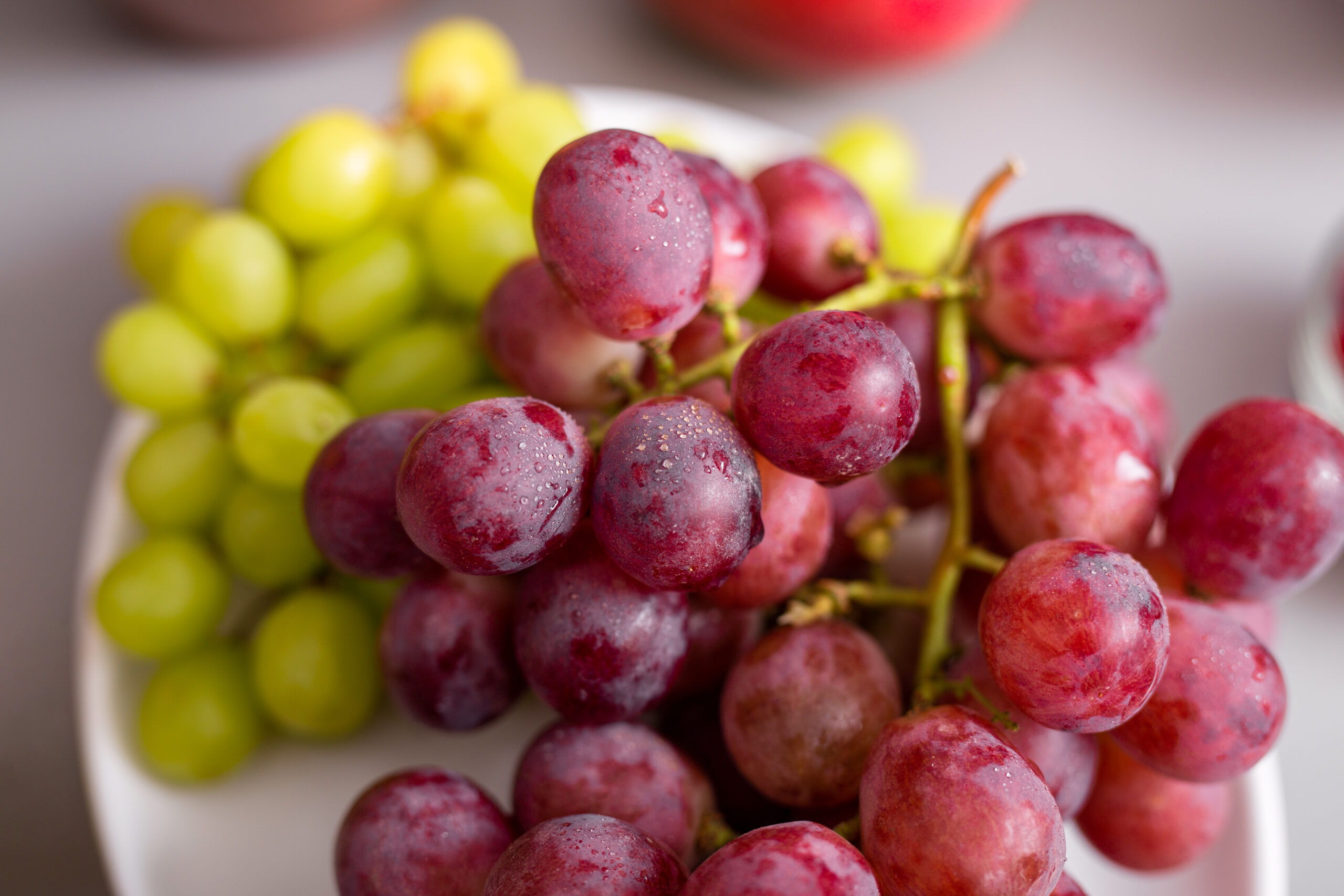
- Year-round: Grapes (the easiest, always works), apple slices (squeeze a little lemon on them to keep them from browning), pear slices
- Summer: Berries, sliced peaches, melon cubes, cherry tomatoes
- Fall/winter: Pomegranate seeds, dried apricots, fig slices, persimmon, sliced pears with honey
- Spring: Strawberries, snap peas, baby carrots
Don't skip vegetables. A few cherry tomatoes, snap peas, mini bell peppers, or radishes break up the richness of the meat-cheese-cracker base and give light eaters something to graze on.
5. Small Extras (Olives, Nuts, Spreads, Honey)
Portion: 1-2 tablespoons per person across all your small extras combined.
These are the items that elevate a basic board into something special. Plan for 2-3 different small extras for small boards, 4-5 for medium boards, and 6+ for grazing tables.
The "always include" list:
- One sweet — honey, fig jam, apricot preserves, or a fruit chutney. Pairs especially well with brie and aged cheddar.
- One briny — olives (Castelvetrano are the crowd favorite), cornichons, pickled vegetables. Cuts through the richness.
- One crunchy — Marcona almonds, candied walnuts, or salted Marcona-style nuts. Adds texture.
The upgrade extras: Whole-grain mustard, pepper jelly, balsamic-glazed onions, a little dish of olive oil with herbs for dipping bread. Each one is small but adds a flavor moment.
Charcuterie Portion Chart: 10–100 Guests
Based on appetizer-style boards (2-3 oz meat + 2-3 oz cheese per person). Multiply by roughly 1.5× for cocktail hour boards, 2× for meal-style boards, and add 25% per hour after the second hour for long grazing events.
| Guests | Meat | Cheese | Crackers/Bread | Fresh Fruit | Extras |
|---|---|---|---|---|---|
| 10 | 1¼–1¾ lbs | 1¼–1¾ lbs | 40-60 pieces | 2½ cups | ¾ cup |
| 15 | 1¾–2½ lbs | 1¾–2½ lbs | 60-90 pieces | 4 cups | 1 cup |
| 20 | 2½–3 lbs | 2½–3 lbs | 80-120 pieces | 5 cups | 1½ cups |
| 25 | 3–4 lbs | 3–4 lbs | 100-150 pieces | 6¼ cups | 2 cups |
| 30 | 4–5 lbs | 4–5 lbs | 120-180 pieces | 7½ cups | 2 cups |
| 50 | 6–8 lbs | 6–8 lbs | 200-300 pieces | 12½ cups | 3 cups |
| 75 | 9–12 lbs | 9–12 lbs | 300-450 pieces | 18¾ cups | 4½ cups |
| 100 | 12–15 lbs | 12–15 lbs | 400-600 pieces | 25 cups | 6 cups |
Add 10-15% to everything if: you're hosting a heavy-eating crowd, the event runs more than 2 hours, or the charcuterie is the only food being served. Better to have leftovers than to refill mid-party.
For more detailed planning, the how much food for 25–100 guests guide covers the rest of a full spread, and the buffet portion guide handles bigger events.
The 3-3-3 Rule (For Smaller Boards)
For boards serving up to 12 guests, the 3-3-3 rule is the easiest way to plan variety: 3 cheeses, 3 meats, 3 extras. It's the minimum variety that makes a board feel intentional rather than thrown together, and it scales naturally:
- 12 guests: 3 cheeses, 3 meats, 3 extras (the original 3-3-3)
- 20 guests: 4 cheeses, 3-4 meats, 4-5 extras
- 30+ guests: 5-6 cheeses, 4-5 meats, 6+ extras
The 3-3-3 rule isn't about exact counts — it's about coverage. Three cheeses across soft/semi-firm/hard guarantees every cheese-eater finds one they love. Three meats across mild/spicy/robust does the same for the meat lovers. Three extras across sweet/briny/crunchy means every cracker bite can be different.
Past 30 guests, you're just scaling variety to keep things interesting. There's no rule that says you can't put 8 cheeses on a 50-person grazing table — you absolutely can, and it looks beautiful.

Real-Life Example: Evening Gathering for 12
Here's how the math plays out for a real event. Twelve guests, 7-10pm, the board is the food for the evening, no follow-up meal. This is an evening grazing board (3 oz meat + 3 oz cheese per person), and the event is 3 hours, so we're adding 15% buffer.
The shopping list:
- Prosciutto: 12 oz (about ¾ lb)
- Calabrese salami: 12 oz
- Soppressata: 12 oz
- Brie: 12 oz (one full wheel)
- Aged Manchego: 10 oz
- Aged cheddar: 10 oz
- Goat cheese log: 8 oz
- Crackers: 80-100 pieces total (2 boxes water crackers + 1 sliced baguette)
- Grapes: 2 cups
- Strawberries or seasonal fruit: 2 cups
- Marcona almonds: ½ cup
- Castelvetrano olives: ½ cup
- Fig jam: 1 small jar
- Honey: 1 small jar
- Whole-grain mustard: 1 small jar
Total food cost (rough estimate): $80-110 depending on where you shop. Costco and Trader Joe's run cheaper; specialty cheese shops run higher.
Time to assemble: About 25 minutes if everything is pre-portioned. Pull cheeses out of the fridge 45 minutes before guests arrive so they reach room temperature — cold cheese tastes flat and grates against the wine.
What guests typically actually eat: Most of the brie, most of the prosciutto, about 70% of the salami, most of the cheddar, half the manchego, most of the grapes, all the olives, all the honey. Leftover meat keeps in the fridge for 4-5 days; leftover hard cheese for 2 weeks.

Common Mistakes (and How to Fix Them)
These are the mistakes that turn a beautiful charcuterie spread into a frustrating one.
Running Out of Crackers Halfway Through
The single most common charcuterie mistake. Crackers disappear at 2-3× the rate you'd expect because they're the vehicle for everything else. Guests grab a cracker to scoop cheese, another to load meat, another for fig jam.
The fix: Buy 50% more crackers than the chart suggests, and stash backup crackers under the counter for refilling. Or slice a baguette and have the extra slices ready to put out when the original batch runs low.
Putting Cheese Out Cold
Cold cheese tastes muted and feels rubbery. Soft cheeses especially (brie, camembert) need 45-60 minutes at room temperature to develop their actual flavor.
The fix: Pull cheeses out of the fridge at least 30-45 minutes before guests arrive. Hard cheeses (parmesan, aged cheddar) can sit out longer — soft cheeses (brie, goat cheese) hit their best texture around 45 minutes and start to get oily after 2-3 hours, so don't leave them out indefinitely.
Buying Pre-Sliced Meats When You Don't Need To
Pre-sliced charcuterie costs 30-50% more per ounce than the same meat sliced at the deli counter. Pre-packaged portions are also bigger than what you actually need — you end up with leftover meat that won't get used.
The fix: For boards serving 20+ guests, go to a deli counter and have them slice exactly what you need. You'll save money and get fresher meat. For smaller boards, pre-sliced is fine because the cost difference is minor.
Not Having Enough Variety
A board with one meat, one cheese, and crackers feels sparse no matter how much you put on it. Variety is what makes a board feel generous — three cheeses arranged on the board look like more food than the same total weight of one giant cheese block.
The fix: Always hit the 3-3-3 minimum (three meats, three cheeses, three extras), even for small gatherings. The variety matters more than the quantity for how the board feels to guests.
Forgetting Vegetables and Light Items
Most home boards skew heavy — all meat, cheese, and crackers. Guests who want lighter bites have nothing to grab.
The fix: Add cherry tomatoes, snap peas, mini bell peppers, sliced cucumber, or radishes. Even just a small bowl of olives or pickled vegetables breaks up the richness and gives light eaters something to graze on. You'll be surprised how fast the vegetables disappear.
Underestimating Long Events
Boards drain faster the longer they sit out. A board that's perfect for a 2-hour gathering will look picked-over and sad at hour 3.
The fix: Plan for refresh batches. Keep 25-30% of your meat, cheese, and extras in the fridge as a "second wave" you can put out when the original board starts looking thin. Re-cutting cheese mid-party only takes 5 minutes and resets the visual appeal of the spread.
Forgetting Knives and Serving Tools
Guests can't serve themselves cheese without knives. They can't dip honey without a spoon. They can't grab olives without a small fork or pick.
The fix: Plan for one knife per cheese (or one cheese knife with a magnetic-style handle that switches between cheeses), one small spoon per spreadable item, and toothpicks or small picks for olives and antipasti. The ultimate party planning equipment list covers the full setup.
FAQ
How much charcuterie per person for a party?
For most parties, plan 2-3 ounces of cured meat and 2-3 ounces of cheese per person when the board is an appetizer, plus 4-6 crackers, ¼ cup of fruit, and 1-2 tablespoons of small extras. That's roughly 4-6 ounces of charcuterie food per person total. For a 20-person party as appetizers, that's about 2½-3 pounds of meat and 2½-3 pounds of cheese.
How much charcuterie for 20 people?
For 20 guests as an appetizer: about 2½–3 pounds of meat (across 3 varieties), 2½–3 pounds of cheese (across 3 varieties), 80-120 crackers, 5 cups of fruit, and 1½ cups of mixed extras. If charcuterie is the main meal for 20 people, double the meat and cheese amounts to 5-6 pounds each.
How much charcuterie for 50 people?
For 50 guests as an appetizer: 6-8 pounds of meat (across 4-5 varieties), 6-8 pounds of cheese (across 5-6 varieties), 200-300 crackers, 12½ cups of fruit, and 3 cups of mixed extras. Plan to refresh the board halfway through if the event runs more than 2 hours.
How many meats should a charcuterie board have?
The 3-3-3 rule recommends three meats for small boards (up to 12 guests). For 12-30 guests, plan 3-4 meats. For 30+ guests, plan 4-5 meats. The ideal mix is one mild (prosciutto, mortadella), one spicy (soppressata, hot calabrese, chorizo), and one robust or smoked (speck, jamón serrano, capocollo).
How many cheeses should a charcuterie board have?
Three cheeses minimum for any board — one soft (brie, goat cheese), one semi-firm (gouda, havarti, manchego), and one firm or strong (aged cheddar, parmesan, blue cheese). For boards serving 30+ guests, add a fourth cheese for variety. Cheese variety matters more than meat variety because cheese is more versatile in flavor combinations.
Can a charcuterie board be a full meal?
Absolutely. For charcuterie as the main meal, double the appetizer portions: 4-6 ounces of meat and 4-6 ounces of cheese per person. Add bread (not just crackers), a green salad, and consider a soup if it's winter. A meal-style board for 8 people needs roughly 2 pounds of meat, 2 pounds of cheese, a real loaf of bread, and a substantial salad.
How far ahead can I prep a charcuterie board?
Most of it can be done the day before. Cut cheese into chunks and store in airtight containers — they hold for 2-3 days refrigerated. Wash and prep fruit the night before. Slice baguette and toast in the morning. The only assembly that needs to happen close to serving is arranging the board itself (about 20-25 minutes), and pulling cheese out 45 minutes before guests arrive to reach room temperature.

How long can a charcuterie board sit out?
Up to 2 hours safely at room temperature, per USDA food safety guidelines. For longer events, plan to refresh the board with cold backup items rather than leaving the same meat and cheese sitting out for 3-4 hours. Soft cheeses (brie, goat cheese) start to look oily after 2 hours and should be replaced or moved back to the fridge.
What's the best meat for a charcuterie board?
Prosciutto is the most universal crowd-pleaser — mild, salty, sliced thin. Salami (especially soppressata or calabrese) adds spice and texture. For something different, try speck (smoked prosciutto), jamón serrano, or capocollo. For a smoked option, smoked turkey or hard salami both work well.
What's the best cheese for a charcuterie board?
For mass appeal: brie (soft), aged cheddar (firm), and a mid-aged gouda or manchego (semi-firm). For more adventurous boards: goat cheese with herbs (soft), gruyère (firm), and blue cheese for the blue cheese fans. The key is variety across textures — soft, semi-firm, and firm — more than picking specific cheeses.
Can I make a charcuterie board without meat?
Yes, easily. Replace cured meats with marinated artichokes, roasted red peppers, hummus, white bean dip, marinated mushrooms, and additional cheese varieties. Vegetarian boards work especially well when you lean into bigger cheese variety (5-6 cheeses instead of 3) and add more substantial accompaniments like olive tapenade, baba ghanoush, or whipped feta.
Final Thoughts
Charcuterie portion math is simple once you know what the board is doing. 2-3 ounces of meat and cheese per person when it's an appetizer. Double that when it's the meal. Add 25% per hour after the second hour if it's a grazing event. Hit the 3-3-3 minimum for variety. Pull the cheese out early so it tastes like cheese instead of cold rubber.
The most common mistake isn't buying too little — it's buying the wrong mix. Three cheeses, three meats, three extras gets you 90% of the way to a beautiful board regardless of how many guests are coming. The portion sizes scale, but the variety principle stays the same.
For everything else at your gathering, the ultimate party food planning guide covers full meal planning, the how to build a charcuterie board guide walks through the actual visual assembly, and the how to build a dessert charcuterie board guide covers the sweet version of all this for dessert spreads.
If you're planning a bigger event with multiple food categories, these guides cover the rest:
- How much food for 25–100 guests — the full party spread breakdown
- How many appetizers per person — when you have multiple appetizer options
- Buffet portion guide — for larger sit-down or buffet events
- How many drinks per person — for the beverage side of the party
The charcuterie part is honestly the easiest part of hosting. It's mostly assembly. The bigger work is the rest of the menu — and the calculators and guides above have all of that math handled.
Related
Looking for other recipes like this? Try these:
- Mac and Cheese for a Crowd: Exact Amounts for 25, 50, 75, and 100 (Free Calculator)
- How Much Turkey Per Person? (Plus a Free Calculator for Any Crowd)
- Sourdough Recipe Scaler: Exact Math for 1 to 10 Loaves (Free Calculator)
- Baked Potato Bar for a Crowd: Exact Potatoes & Toppings (10–100 Guests + Calculator)
Pin to Pinterest