I used to buy way too much ice. Or way too little. There was no in-between.
For years, every party started with me standing in the gas station ice aisle, staring at the cooler door, doing weird math in my head — is 20 pounds enough for 30 people? Should I get 40? What if it's hot outside? Half the time I'd come home with too much and watch it melt into the driveway. The other half I was making an ice run at 8 PM in flip-flops while my guests waited.
Here's the thing. There's actually a real number. Caterers and ice suppliers have been quietly running this math forever, and it's not complicated once you know the formula. You need to know three things: how many people, what kind of event, and how hot it'll be. That's it.
Below, I'll give you the quick answer first, then a calculator that does the full math for you (kids, weather, length of event, food display ice — all of it). Then a printable chart you can screenshot before you head to Costco.
No more guessing. No more 8 PM ice runs.
Jump to:
- Quick Answer: How Much Ice Per Person?
- Ice calculator
- Why Ice Math Matters More Than You Think
- Why Ice Estimates Online Are So Different
- The 4 Factors That Determine Your Ice Needs
- Pounds of Ice for Any Party: The Quick Reference Chart
- How to Calculate Ice for Your Specific Party (Step by Step)
- A Real Example: 50-Person Summer BBQ
- Cubed vs. Crushed vs. Nugget Ice: Does It Matter?
- Where to Buy Ice (And How Much It Costs)
- Troubleshooting: Common Ice Problems and Fixes
- FAQ
- Final Thoughts
- Related
- Pin to Pinterest
Quick Answer: How Much Ice Per Person?
Plan for 1 to 3 pounds of ice per adult, depending on event type, weather, and length:
| Event type | Ice per person |
|---|---|
| Indoor dinner party | 1 lb |
| Casual party / BBQ | 1.5 lbs |
| Cocktail party / open bar | 2 lbs |
| Wedding / reception | 2 lbs |
| Game day / tailgate | 2 lbs |
| Pool party (any temp) | 2 lbs |
| Pool party (90°F+ hot day) | about 2.3 lbs |
Kids under 12 = half the adult amount (they drink less, and less of what they drink is iced).
Then add 20% on top for melt, transit loss, and the friend who shows up with two uninvited cousins.
That gets you very close for most parties. A 50-person hot-weather cookout? Closer to 100 pounds of ice, or about 15 standard 7-lb bags. A 100-person wedding with cocktails? 240 pounds, or about 35 bags (or 12 of the 20-lb bulk bags from Costco).
For the exact number for your party — plus weather and event length adjustments — use the calculator below. And if you're still working out how many drinks per person, that's the next number to lock in — check the drinks per person guide.
Ice calculator
ICE CALCULATOR
Get exact pounds of ice and bag counts for any party — every event type, weather, and length figured out for you.
| Use | Pounds | Notes |
|---|
| Guests | Dinner (indoor) | Casual / BBQ | Cocktail party | Pool / hot day |
|---|---|---|---|---|
| 10 | 12 lbs2 bags | 18 lbs3 bags | 24 lbs4 bags | 24 lbs4 bags |
| 20 | 24 lbs4 bags | 36 lbs6 bags | 48 lbs7 bags | 47 lbs7 bags |
| 30 | 36 lbs6 bags | 54 lbs8 bags | 72 lbs11 bags | 71 lbs11 bags |
| 50 | 60 lbs9 bags | 90 lbs13 bags | 120 lbs18 bags | 117 lbs17 bags |
| 75 | 90 lbs13 bags | 135 lbs20 bags | 180 lbs26 bags | 176 lbs26 bags |
| 100 | 120 lbs18 bags | 180 lbs26 bags | 240 lbs35 bags | 234 lbs34 bags |
Why Ice Math Matters More Than You Think
Running out of ice doesn't ruin a party, but it absolutely dampens it. Once the drinks go from cold to lukewarm, people stop drinking them. The line at the bar slows down. The cooler becomes a sad puddle of warm water and floating cans.
Buying too much isn't free either. Twenty extra pounds of ice is twenty pounds you stored, hauled, and watched melt for nothing. Plus, if you're throwing a bigger event, ice prices add up fast — five bucks here, six bucks there, and suddenly you've spent forty dollars on water.
The good news: ice math is one of the most forgiving party calculations there is. Unlike meat or appetizers, where over-buying means leftovers nobody wants, extra ice has uses. Stick it in the freezer for next time. Use it in a cooler. Toss it in the yard if you have to. The point is, you want to err slightly on the high side, and the calculator builds that in automatically.
Here's what actually affects how much you need.
Why Ice Estimates Online Are So Different
If you've already Googled this question, you've seen a wild range — from 1 lb per person to 4 lbs per person. The reason isn't that one source is wrong. They're just answering different questions.
Ice does three completely different jobs at a party, and most calculators silently bundle them together (or miss one entirely). Once you understand the three jobs, the numbers start making sense.
Job 1: Serving ice (the ice that goes in glasses)
This is the ice in your guests' cups — for water, soda, lemonade, iced tea, cocktails. The catering rule: about half a pound of ice per iced drink. That covers what goes in the cup at first pour, plus refills and a little melt during the drink.
If you're mostly serving canned and bottled drinks, serving ice is almost zero. If you're hosting a cocktail party with mixed drinks, serving ice is the biggest single piece of your total.
Job 2: Chilling ice (the ice around bottles and cans in the cooler)
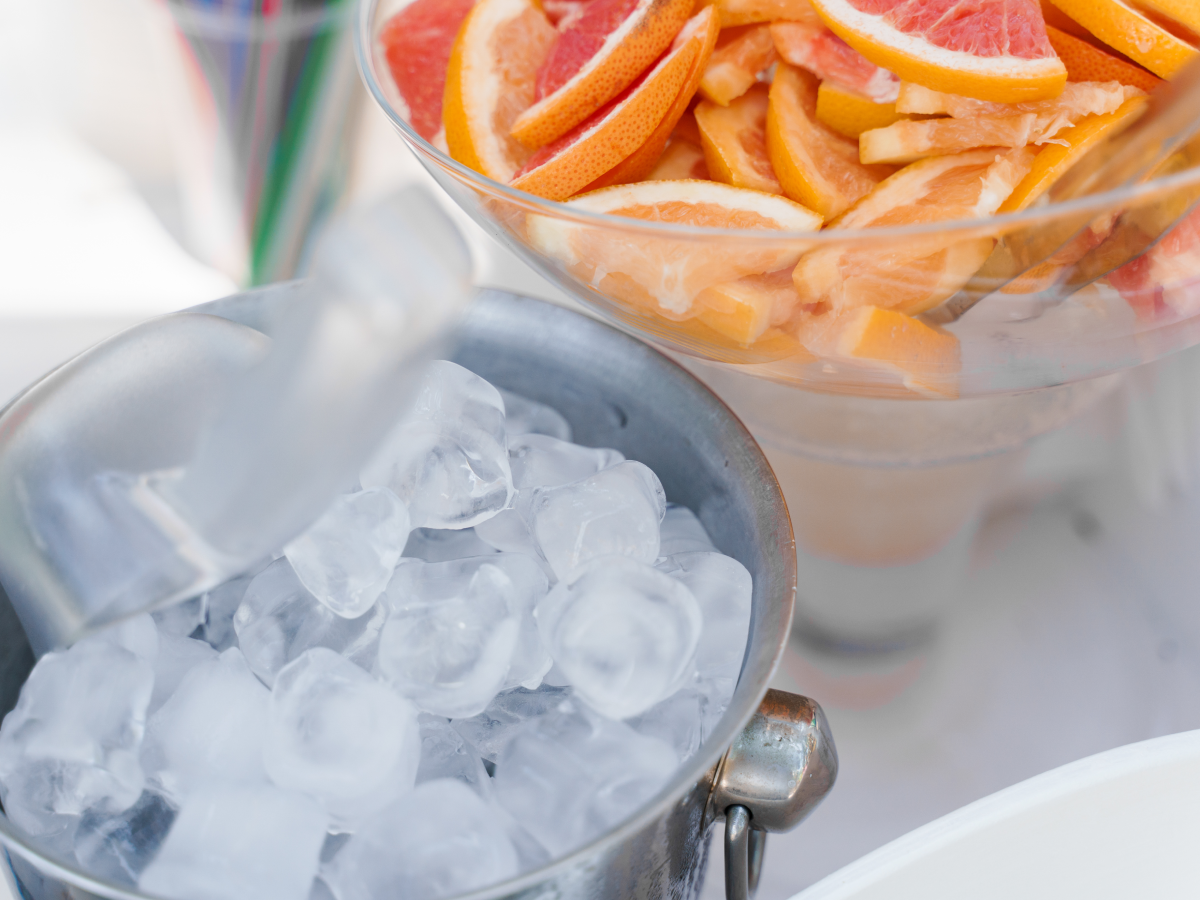
This is what keeps your drinks cold. The general rule: 1 to 1.5 lbs per gallon of beverage, or roughly 1 lb per guest if you're chilling a typical mix of cans and bottles. A standard 48-quart cooler holds about 50–60 cans plus 20–30 lbs of ice to be effective.
The base amount stays roughly the same indoors or outdoors — but the ice melts faster outdoors, so you'll need to top off coolers throughout the event.
Job 3: Food display ice (the ice under raw bar platters)
If you're serving shrimp cocktail, oysters, sushi, or a charcuterie board with meats and cheeses, food display ice keeps everything below 40°F so it stays safe to eat. Plan about 1 lb per guest extra if you're doing this, and use a separate container so the food ice never mixes with drink ice.
For most home parties, you can skip this entirely. It mainly matters for weddings, formal events, or anything with raw seafood.
The takeaway: when you see "1 lb per person" online, that's usually serving ice OR chilling ice — not both. When you see "3 lbs per person," that's usually a hot outdoor cocktail party with all three jobs combined plus a buffer. Both can be correct for their context. The calculator above bundles all three jobs into a single recommendation based on your specific event.
The 4 Factors That Determine Your Ice Needs
1. Number of guests (and how many are kids)
Adults consume more ice than kids — they have more drinks, those drinks are more often iced, and they're more likely to be drinking cocktails. The calculator counts kids at 50% of the adult rate, which is the catering-standard split.
If your event is family-heavy (think birthday parties or family reunions), don't just multiply by total headcount. You'll overbuy. Use the adult/kid split.
2. Event type
This is the biggest factor, and it's where most people miscalculate. A dinner party uses almost no ice — guests sit, sip drinks from glasses, and refill maybe twice. A cocktail party uses a ton — every drink has ice, the bar runs continuously, and bottles need chilling. A pool party in July? Plan for about double a dinner party.
The pill row in the calculator handles this automatically. Pick the event that matches yours, and the base lbs-per-person is set.
3. Weather and setting
Heat is the enemy of ice. In a climate-controlled indoor space (70–74°F), ice melts at a predictable, slow rate. Outdoor events with direct sunlight or wind drastically increase melt rates. The general rule from the catering industry:
- Under 80°F: standard amount
- 80–90°F: add about 25%
- 90°F+: add about 30%
This is exactly what the calculator does when you toggle between indoor, mild, warm, and hot.
4. Event length
A 2-hour brunch doesn't need the same ice as a 6-hour wedding reception. For longer events, plan on adding more ice per cooler every 4 hours to account for melt and refills. The calculator scales for this — short events get less, long events get a 20–35% bump.
Pounds of Ice for Any Party: The Quick Reference Chart
Screenshot this. Save it to your phone. Bring it to Costco.
Pounds of Ice for Any Party (3–4 hr event, buffer included)
| Guests | Dinner (indoor) | Casual / BBQ | Cocktail party | Pool / hot day |
|---|---|---|---|---|
| 10 | 12 lbs2 bags | 18 lbs3 bags | 24 lbs4 bags | 24 lbs4 bags |
| 25 | 30 lbs5 bags | 45 lbs7 bags | 60 lbs9 bags | 59 lbs9 bags |
| 50 | 60 lbs9 bags | 90 lbs13 bags | 120 lbs18 bags | 117 lbs17 bags |
| 75 | 90 lbs13 bags | 135 lbs20 bags | 180 lbs26 bags | 176 lbs26 bags |
| 100 | 120 lbs18 bags | 180 lbs26 bags | 240 lbs35 bags | 234 lbs34 bags |
| 150 | 180 lbs26 bags | 270 lbs39 bags | 360 lbs52 bags | 351 lbs51 bags |
| 200 | 240 lbs35 bags | 360 lbs52 bags | 480 lbs69 bags | 468 lbs67 bags |
| 300 | 360 lbs18 bulk bags | 540 lbs27 bulk bags | 720 lbs36 bulk bags | 702 lbs36 bulk bags |
| 500 | 600 lbs30 bulk bags | 900 lbs45 bulk bags | 1,200 lbs60 bulk bags | 1,170 lbs59 bulk bags |
Bag counts are standard 7-lb grocery-store bags up to 200 guests. For 300+ guests, counts shown are bulk bags. Bulk bags = 20-lb bags — at that scale, order delivery from an ice supplier. Includes a 20% safety buffer.
For most home parties, you'll buy 7-lb bags. For anything over 100 pounds, switch to 20-lb bulk bags from Costco, Sam's Club, or an ice supplier — you'll save money and a lot of trips to the freezer.
How to Calculate Ice for Your Specific Party (Step by Step)
Want to do this without the calculator? Here's the math.
Step 1: Pick your base. Look at the chart above or use these per-person base numbers (before weather and duration adjustments):
- Dinner / indoor: 1 lb
- Casual / BBQ: 1.5 lbs
- Cocktail or wedding base: 2 lbs
- Pool party base: 1.5 lbs (same as casual — the hot-weather multiplier does the rest)
Step 2: Multiply by adults, then add kids at half. Example: 30 adults + 10 kids at a casual BBQ = (30 × 1.5) + (10 × 0.75) = 45 + 7.5 = 52.5 lbs
Step 3: Adjust for weather.
- Indoor or under 80°F: no change
- 80–90°F outdoor: multiply by 1.25
- 90°F+ outdoor: multiply by 1.3
So if that same BBQ is outdoors at 85°F: 52.5 × 1.25 = 65.6 lbs
Step 4: Adjust for length.
- 2 hours or less: multiply by 0.85
- 3–4 hours: no change
- 5–6 hours: multiply by 1.2
- 6+ hours: multiply by 1.35
A standard 3–4 hour BBQ keeps the 65.6 lbs. A 5-hour party becomes 65.6 × 1.2 = 78.7 lbs.
Step 5: Add 20% buffer. 78.7 × 1.20 = 94.5 lbs. Round up to 95 lbs, or about 14 standard 7-lb bags.
That's it. Five steps, real numbers, no guessing.
A Real Example: 50-Person Summer BBQ
Let's walk through one of the most common scenarios on this site.
The party: 50 guests (40 adults, 10 kids), backyard BBQ, outdoor in the 85°F afternoon, runs 4 hours from 2 to 6 PM. You've got drinks in coolers, soda for the kids, and a few pitchers of lemonade and iced tea.
The math:
- Base: 40 adults × 1.5 lbs = 60 lbs
- Kids: 10 × 0.75 = 7.5 lbs
- Subtotal: 67.5 lbs
- Weather (warm outdoor +25%): 67.5 × 1.25 = 84.4 lbs
- Duration (3–4 hrs, no change): still 84.4 lbs
- Buffer (+20%): 84.4 × 1.20 = 101 lbs
What to buy: about 15 standard 7-lb bags or 5 of the 20-lb Costco bags. Plan two separate coolers — one for chilling cans and bottles, one for serving ice (the kind that goes in glasses). Keep them in shade, off the concrete, with lids closed between refills.
You can absolutely halve those bag numbers if you're using cocktails-in-pitchers and very little ice-in-glass. You can also add a few bags if you've got a lemonade dispenser running all afternoon. But for a standard summer BBQ, 100 pounds is right in the pocket. Pair this with the chicken wings per person and burgers per person guides to lock in the rest of your menu.
Cubed vs. Crushed vs. Nugget Ice: Does It Matter?
Yes — and this is where a lot of party planning advice falls short. The type of ice you buy directly affects how much you need.
Cubed ice is the standard. It's what comes in most grocery store bags, what cooler companies recommend, and what the calculator above assumes. Use this for general chilling and most drinks.
Crushed or nugget ice (the chewable "Sonic ice" everyone loves) has way more surface area, which means it melts way faster. Use it only for specific cocktails or raw bar displays. If your local store only carries crushed or nugget ice, buy 15–25% more than the calculator recommends. So a 100-lb total becomes a 120-lb purchase.
Block ice is the opposite — large blocks melt incredibly slowly and are perfect for keeping coolers cold for 6+ hours. If you're hosting an all-day event or have a long drive to the venue, throw a few block-ice bags in the bottom of each cooler before adding cubed ice on top. They'll last twice as long.
Dry ice is for special effects (smoke from punch bowls) and emergency long-distance transport — not for drinks. Never put dry ice directly into drinks without proper safety equipment. Skip it unless you've done it before.
For 95% of parties, plain old cubed ice from the gas station is exactly right.

Where to Buy Ice (And How Much It Costs)
Grocery store / gas station — 7-lb bags, usually $3–5 each. Convenient, but you'll make multiple trips for anything over 50 lbs.
Costco / Sam's Club — 20-lb bags, usually $3–4 each. Best value for parties over 50 guests. Plan ahead — they sometimes sell out on holiday weekends.
Ice supplier or delivery service — for events over 100 lbs, an ice supplier (Reddy Ice, Arctic Glacier, local) will often deliver. Pricing per pound drops considerably, and you skip the cooler-stuffing process.
Make your own — only realistic if you have a second freezer dedicated to ice trays for a week. Most home freezers max out around 20–30 lbs of homemade ice if you start filling trays a week ahead.
For a typical home party of 30–60 guests, the sweet spot is mixing two sources: get the bulk of your ice from Costco the morning of, and grab 1–2 backup bags from a nearby gas station to avoid the, "oh no, we're low" moment two hours in.
Troubleshooting: Common Ice Problems and Fixes
"My ice is melting too fast in the cooler." Three causes, usually all at once: cooler in direct sun, cooler on hot concrete, lid getting opened constantly. Fix all three — shade, elevation (a low table works), and assign one person to be the cooler keeper. Heat radiates from the ground, so elevate coolers on tables or stands, and use light colors — white coolers reflect heat while dark coolers absorb it.
"I bought ice the night before and lost half of it." Bagged ice loses 20–30% in a standard freezer in 24 hours because of air pockets and freezer cycling. Buy ice the morning of the party, not the day before. If you absolutely have to buy ahead, get block ice instead of cubed — it lasts much longer.
"My drinks aren't getting cold fast enough." You need an ice bath, not just ice. Two parts ice to one part water creates an ice bath that chills drinks faster than ice alone. Counterintuitive, but true — water transfers cold to bottle surfaces much faster than ice alone does. Add an inch of water to your cooler with the ice.
"I'm running low halfway through the party." Two fixes: send someone to the nearest gas station immediately (always have a designated ice-runner pre-assigned for big parties), and consolidate. Combine all the half-empty coolers into one fully-packed cooler so the ice you have left works harder.
"Should I keep serving ice and chilling ice in separate containers?" Yes, always. Once chilling ice has touched bottle labels, soda can pull-tabs, and wet hands, it's not food-safe to put in drinks. Keep them in two different containers.
FAQ
How many pounds of ice for 50 people? For a casual indoor party, about 60 lbs (9 bags). For a casual BBQ, 90 lbs (13 bags). For a cocktail party or wedding, 120 lbs (18 bags). For a pool party on a hot day, about 117 lbs (17 bags). Includes a 20% safety buffer.
How many pounds of ice for 100 people? For a casual indoor party, about 120 lbs (18 bags). For a casual BBQ, 180 lbs (26 bags). For a cocktail party or wedding, 240 lbs (35 bags, or 12 of the 20-lb bulk bags). For a pool party on a hot day, about 234 lbs (34 bags, or 12 bulk bags — order from a supplier).
How many bags of ice do I need? Most grocery store bags are 7 lbs. Costco and Sam's Club sell 20-lb bags. Divide your total pounds by the bag size and round up. For 50 lbs of ice: 8 standard bags or 3 bulk bags.
Is one pound of ice per person enough? For a short, cool indoor dinner party — yes. For anything outdoors, longer than 3 hours, or with cocktails, you'll want at least 1.5 to 2 pounds per person, plus buffer.
Do I need ice for kids at a party? Less than for adults. The calculator counts kids at 50% of the adult rate, since they drink less overall and less of what they drink is iced. For a family birthday party with 15 adults and 10 kids, plan for about 22 adult-equivalents.
What's the difference between serving ice and chilling ice? Serving ice goes into guests' glasses (drinks, water, lemonade). Chilling ice surrounds bottles and cans in coolers. Both should be kept in separate containers — once chilling ice touches bottle labels and wet hands, it's not food-safe for drinks. Most calculators bundle them together; ours does too, but the breakdown shown after you hit Calculate shows roughly how the total splits across both jobs.
Should I buy extra ice the day before or the day of? Day of. Bagged ice in a home freezer loses 20–30% to melt and air pockets within 24 hours. If you must buy ahead, get block ice (lasts much longer) or use a chest freezer at the lowest setting.
What if I'm using a kiddie pool as a giant cooler? Plan on the higher end of the ice range — kiddie pools and bathtubs aren't insulated, so ice melts roughly twice as fast as in a real cooler. For a 50-person BBQ using a kiddie pool, plan 120+ lbs instead of 90.
How much ice for a wedding of 200 people? For an indoor reception, about 480 lbs. For an outdoor warm-weather reception, plan around 600 lbs, ideally with delivery from an ice supplier and dedicated bar staff managing the cooler refills.
How do I keep ice from melting at an outdoor party? Three things: shade (always), elevation (off the hot ground), and lids closed (assign someone to police this). Use light-colored or insulated coolers, not metal tubs — metal transfers heat fast. Use block ice on the bottom and cubed on top.
Final Thoughts
Ice planning isn't complicated once you know the formula. The number that matters is 1 to 3 pounds per person, adjusted for weather, length, and event type, plus a 20% safety buffer. That's it. Everything else is just the math.
What I want you to take away: don't be the host doing emergency ice runs. Use the calculator at the top of this page to lock in your number a few days before your party, then plan one Costco trip the morning of. If you're hosting more than 50 people, designate one friend as the "ice keeper" — they're in charge of moving bags from the garage to the coolers and making sure lids stay closed. That single move is the difference between a smooth party and a warm-drink disaster at 5 PM.
Save the calculator. Pin the chart. And tell me how your party goes.
Related
Looking for other recipes like this? Try these:

Pin to Pinterest