You found a sourdough recipe you love. Now you need to make four of them for a bake sale, or two for a dinner party, or scale it down to a single loaf because you live alone and don't need 14 slices on the counter.
The instinct is to multiply everything by however many you need. That's where most people go wrong — because doubling a sourdough recipe isn't the same as doubling a cookie recipe. Starter contains both flour and water, which messes up the hydration math the second you scale.
This guide has the actual method. A free calculator that does the math for you, the baker's percentage system explained simply, and the one trap that breaks most online sourdough scalers.
If you don’t want to do the math manually, use the sourdough calculator below — it handles scaling, hydration, and starter adjustments automatically.
Jump to:
- Quick Answer: How to Scale a Sourdough Recipe
- Sourdough Recipe Scaler Calculator
- Why Simple Multiplication Isn't Enough
- What Are Baker's Percentages, Really?
- The Standard Sourdough Formula
- How to Scale Any Recipe in 4 Steps
- The Hydration Trap Most Calculators Miss
- Real Example: Scaling a Recipe to 4 Loaves
- Scaling for a Bake Sale or Party
- Adjusting for Different Starter Hydrations
- Adding Inclusions When Scaling
- Common Scaling Mistakes
- FAQ
- Final Thoughts
- Related
- Pin to Pinterest
Quick Answer: How to Scale a Sourdough Recipe
Here's the rule. Don't memorize a multiplier — memorize the method.
Step 1: Convert your recipe to baker's percentages (flour = 100%, everything else as a percentage of flour).
Step 2: Pick your target. How many loaves, at what dough weight per loaf.
Step 3: Multiply your target total dough weight by your scale factor to get new ingredient amounts.
Step 4: Verify your true hydration didn't shift (it shouldn't, if you scaled correctly).
Or skip all of that and use the calculator below — it does every step automatically and shows you the work.
| What you have | What you want | What changes |
|---|---|---|
| 1 loaf recipe | 4 loaves | Every ingredient × scale factor |
| Standard recipe | Mini loaves (400g) | Same ratios, smaller scale factor |
| Recipe in cups | Recipe in grams | Convert first, then scale |
If you're new to weighing ingredients in grams, the calculator will do the math but you'll need a kitchen scale. Cup measurements scale too unevenly past one loaf.
Sourdough Recipe Scaler Calculator
Enter your recipe, pick how many loaves you need, and the calculator gives you exact ingredient amounts in grams plus your true hydration percentage and baker's percentages.
SOURDOUGH RECIPE SCALER
Scale any sourdough recipe to the exact number of loaves you need — true hydration and baker's percentages calculated for you.
| Ingredient | Amount | Notes |
|---|
| Loaves | Flour | Water | Starter | Salt |
|---|---|---|---|---|
| 1 | 500g | 350g | 100g | 10g |
| 2 | 1,000g | 700g | 200g | 20g |
| 4 | 2,000g | 1,400g | 400g | 40g |
| 6 | 3,000g | 2,100g | 600g | 60g |
| 8 | 4,000g | 2,800g | 800g | 80g |
| 10 | 5,000g | 3,500g | 1,000g | 100g |
Why Simple Multiplication Isn't Enough
You can multiply a sourdough recipe and it works perfectly when you're scaling evenly. Doubling 500g of flour to 1,000g, doubling the water to 700g, doubling everything else — that gives you a recipe with the same ratios and the same dough behavior, just twice as much.
The problem starts when you want something more specific. Scale to a target dough weight — say, two 900g loaves (1,800g total) — and the math gets fuzzy. Adjust the hydration, swap to a different starter, or use a starter at a different hydration than the original recipe called for, and simple multiplication falls apart.
Here's why. Your starter isn't just a leavener — it's flour and water in disguise. A 100g sourdough starter at 100% hydration already contains 50g of flour and 50g of water. So when you write your recipe as "500g flour + 350g water + 100g starter," your dough actually contains 550g of total flour and 400g of total water. That's where your true hydration percentage comes from.
Multiply everything by 2 and the ratios stay the same — easy. But the moment you stop scaling evenly, you have to know which numbers represent real flour and which represent flour hiding in the starter. Otherwise you'll trip up trying to:
- Adjust the hydration of a scaled recipe
- Use a starter at a different hydration than the original recipe assumed
- Calculate how much dough you'll have for a specific banneton or pan
- Scale to a target loaf weight instead of a target multiplier
That's why baker's percentages exist. They make scaling foolproof — once you understand them, every sourdough recipe in the world becomes scalable.
What Are Baker's Percentages, Really?
Baker's percentages are how professional bakers communicate recipes. The system has one rule:
Flour is always 100%. Every other ingredient is calculated as a percentage of the flour.
That's it. Once you understand that one rule, every sourdough recipe in the world becomes scalable.
A recipe with 500g flour, 350g water, 100g starter, and 10g salt looks like this in baker's percentages:
| Ingredient | Weight | Baker's % |
|---|---|---|
| Flour | 500g | 100% |
| Water | 350g | 70% (350 ÷ 500) |
| Starter | 100g | 20% (100 ÷ 500) |
| Salt | 10g | 2% (10 ÷ 500) |
The numbers add up to more than 100%. That's normal — they're percentages of the flour, not of the total dough.
Once you have your recipe in percentages, you can scale to any size. Want 4 loaves at 900g each? That's 3,600g of total dough. Calculate backwards from there: how much flour gets you to 3,600g total when you also factor in the water, starter, and salt? The calculator does this part for you.
For a much deeper dive into different sourdough techniques and starter math, the 25 sourdough discard recipes guide covers what to do with leftover starter when you scale a recipe down.
The Standard Sourdough Formula
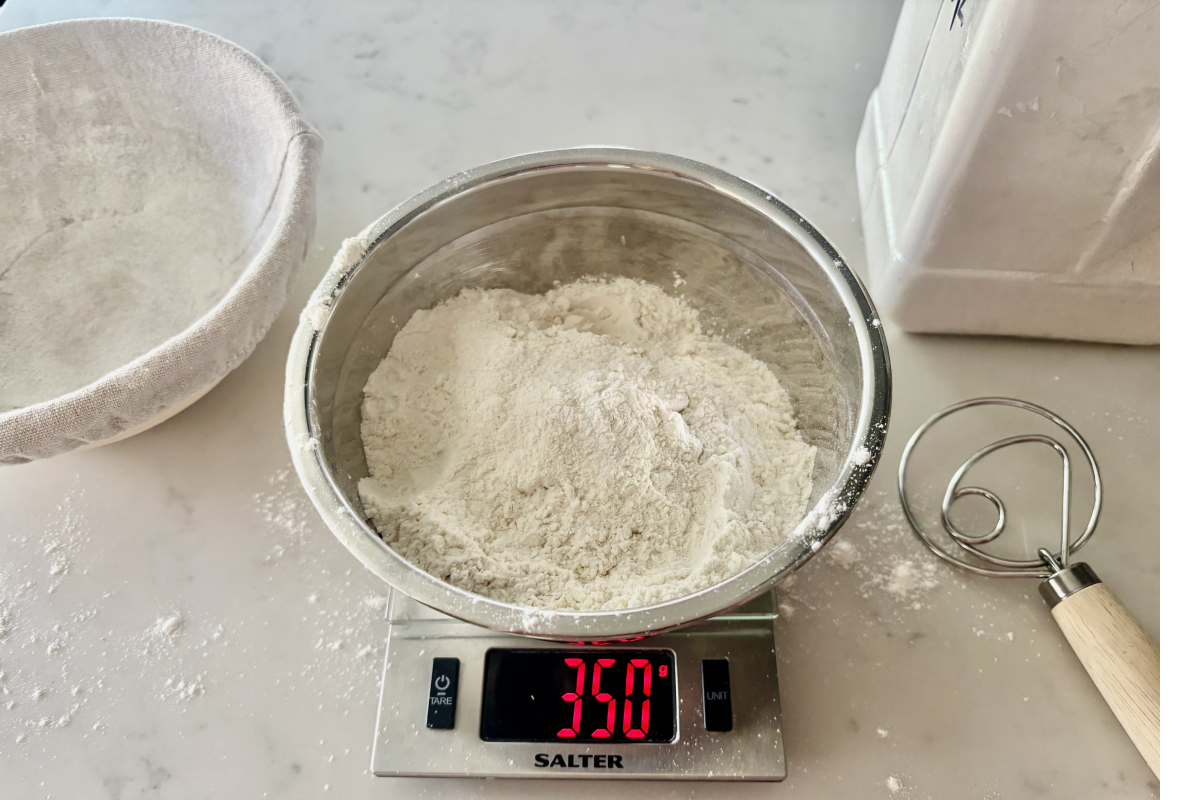
If you're just learning baker's percentages, this is the formula to memorize. It's the most widely-cited "standard sourdough" recipe across professional and home-baking sources:
100% flour · 70% water · 20% starter · 2% salt
That's the foundation. Almost every classic sourdough recipe is a variation on these four numbers. Here's how the percentages shift across common bread styles:
| Bread style | Hydration | Starter | Notes |
|---|---|---|---|
| Beginner sourdough | 65–70% | 10–20% | Easy to handle, tight crumb |
| Classic artisan loaf | 70–75% | 15–25% | The standard sweet spot |
| High-hydration artisan | 75–85% | 15–25% | Open crumb, sticky dough |
| Sandwich loaf | 60–68% | 10–20% | Stiffer dough, holds shape |
| Pan loaf with butter/honey | 60–65% | 10–15% | Enriched, soft texture |
| No-knead style | 85%+ | 8–18% | Wet batter-style dough |
Salt stays at 1.8–2% across almost all sourdough styles. Less than 1.8% and the dough is bland and over-ferments. Above ~2.2%, salt noticeably slows fermentation — not a hard cutoff, but enough to throw off your timing.
Starter percentage is mostly about timing. More starter = faster rise. Less starter = slower rise with more flavor development. In a warm kitchen (above 75°F), drop your starter to 10–15%. In a cold kitchen (below 66°F), bump it up to 25–30%.
How to Scale Any Recipe in 4 Steps
Here's the actual method, written out so you can do it without the calculator if you want.
Step 1: Convert your recipe to baker's percentages.
Take each ingredient weight and divide it by the flour weight, then multiply by 100. So if your recipe has 500g flour and 350g water, your water percentage is (350 ÷ 500) × 100 = 70%.
Do this for every ingredient. Flour is always 100%, even though you're not "calculating" it — that's just the rule.
Step 2: Calculate your original total dough weight.
Add up every ingredient: flour + water + starter + salt + any inclusions. For a 500/350/100/10 recipe, that's 960g of total dough.
Step 3: Decide your target.
How many loaves do you want, and at what weight per loaf? A standard sourdough boule is 900g. Mini loaves are 400g. Pan loaves are usually 800–900g. Multiply loaves × per-loaf weight = your target total dough.
For 4 standard loaves: 4 × 900g = 3,600g target.
Step 4: Calculate your scale factor and multiply.
Scale factor = target total ÷ original total. So 3,600g ÷ 960g = 3.75×.
Now multiply every original ingredient by 3.75. Flour: 500g × 3.75 = 1,875g. Water: 350g × 3.75 = 1,313g. Starter: 100g × 3.75 = 375g. Salt: 10g × 3.75 = 38g.
That's your scaled recipe. The percentages stay identical, which means the dough will behave the same — same hydration, same flavor profile, same fermentation timing.
The Hydration Trap Most Calculators Miss
Here's the part most online sourdough scalers get wrong. Even some popular ones.
True hydration includes water from your starter. Many simple calculators — and a lot of recipes — don't account for it.
Take a 500g flour, 350g water, 150g starter recipe at 100% starter hydration. Naive math says: hydration = 350 ÷ 500 = 70%.
Real math says: that 150g starter contains 75g of flour and 75g of water. So total flour = 575g, total water = 425g. True hydration = 425 ÷ 575 = 73.9%.
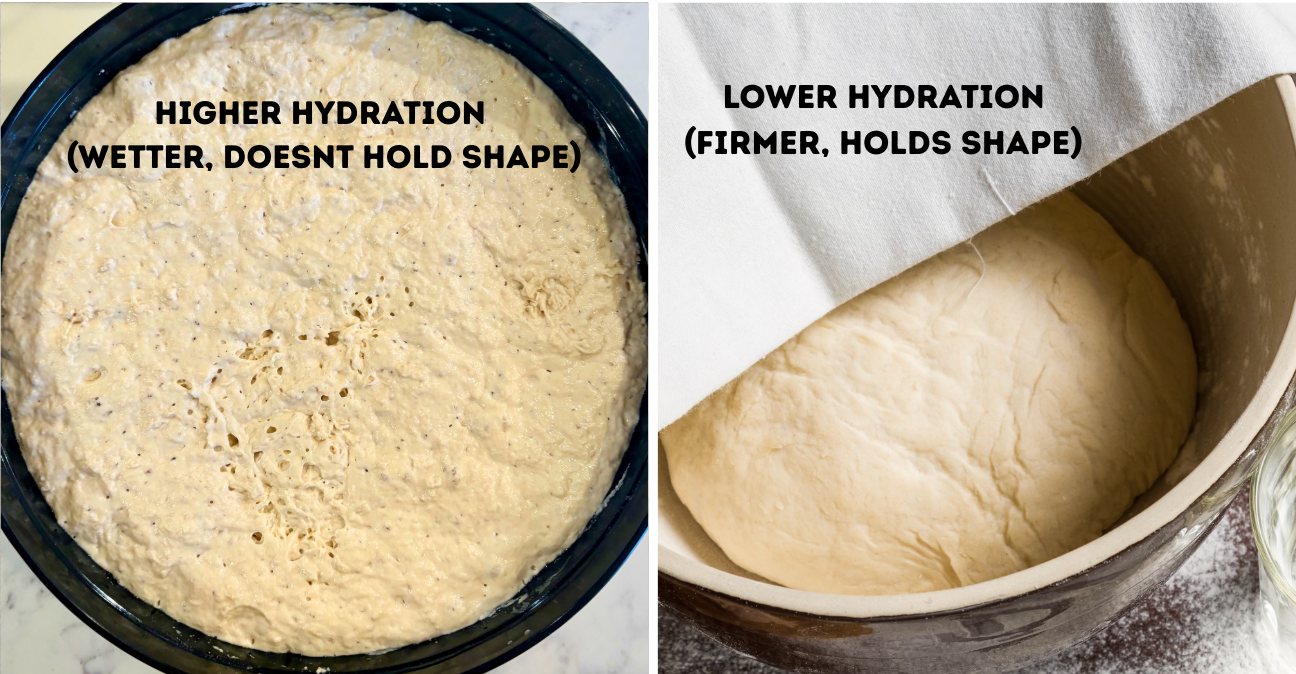
That's a 4-percentage-point difference. At 70% hydration, you have a manageable artisan loaf. At 74%, you have a notably stickier dough that needs more careful handling. Same recipe, different number, completely different baking experience.
The calculator above shows you the true hydration — the one that includes starter water. That's the number that actually predicts how your dough will behave.
This matters most when you're:
- Scaling down a high-starter recipe. A recipe with 30% starter has more "hidden" water than one with 15%.
- Switching to a different starter hydration. A stiff starter (50% hydration) contributes less water than a 100% starter, even at the same total starter weight.
- Comparing two recipes from different bloggers. They might be writing different "hydration" numbers for what's actually the same dough.
If you ever wondered why some sourdough recipes feel wetter than the percentage on the page suggests, this is why.
Real Example: Scaling a Recipe to 4 Loaves
Let's run through it with real numbers. Imagine you have a basic sourdough recipe:
Original recipe (1 loaf):
- 500g flour
- 350g water
- 100g sourdough starter (100% hydration)
- 10g salt
- Total: 960g dough
You want 4 loaves at 900g each (3,600g total).
Calculate the scale factor. 3,600 ÷ 960 = 3.75×.
Multiply every ingredient.
| Ingredient | Original | × 3.75 | Scaled |
|---|---|---|---|
| Flour | 500g | × 3.75 | 1,875g |
| Water | 350g | × 3.75 | 1,313g |
| Starter | 100g | × 3.75 | 375g |
| Salt | 10g | × 3.75 | 38g |
Verify the percentages didn't drift.
- Water: 1,313 ÷ 1,875 = 70% ✓
- Starter: 375 ÷ 1,875 = 20% ✓
- Salt: 38 ÷ 1,875 = 2% ✓
Same ratios. Same dough behavior. Just 4× the volume.
Note the practical reality. You'll need a big bowl. 3,600g of dough is heavy and bulky. Most home stand mixers max out around 1,500–2,000g of dough — for 4 loaves you'll likely mix by hand, or split the batch in half and mix separately.
Scaling for a Bake Sale or Party
Real-world batch baking comes with logistics the calculator can't solve for you. Here's what to think through before you scale up.
Equipment limits. A standard home oven holds 2 Dutch ovens at most, or one large sheet pan with 3–4 batards. If you're baking 6+ loaves, you're either staggering batches across multiple bake cycles or using bread pans on multiple racks. Plan for 60–90 minutes per batch including pre-heat.
Bowl size for bulk fermentation. 3,600g of dough needs at least a 6-quart bowl with room to grow. 5,400g (6 loaves) needs 8 quarts. 9,000g (10 loaves) is borderline impossible to ferment in one bowl — split into two batches.
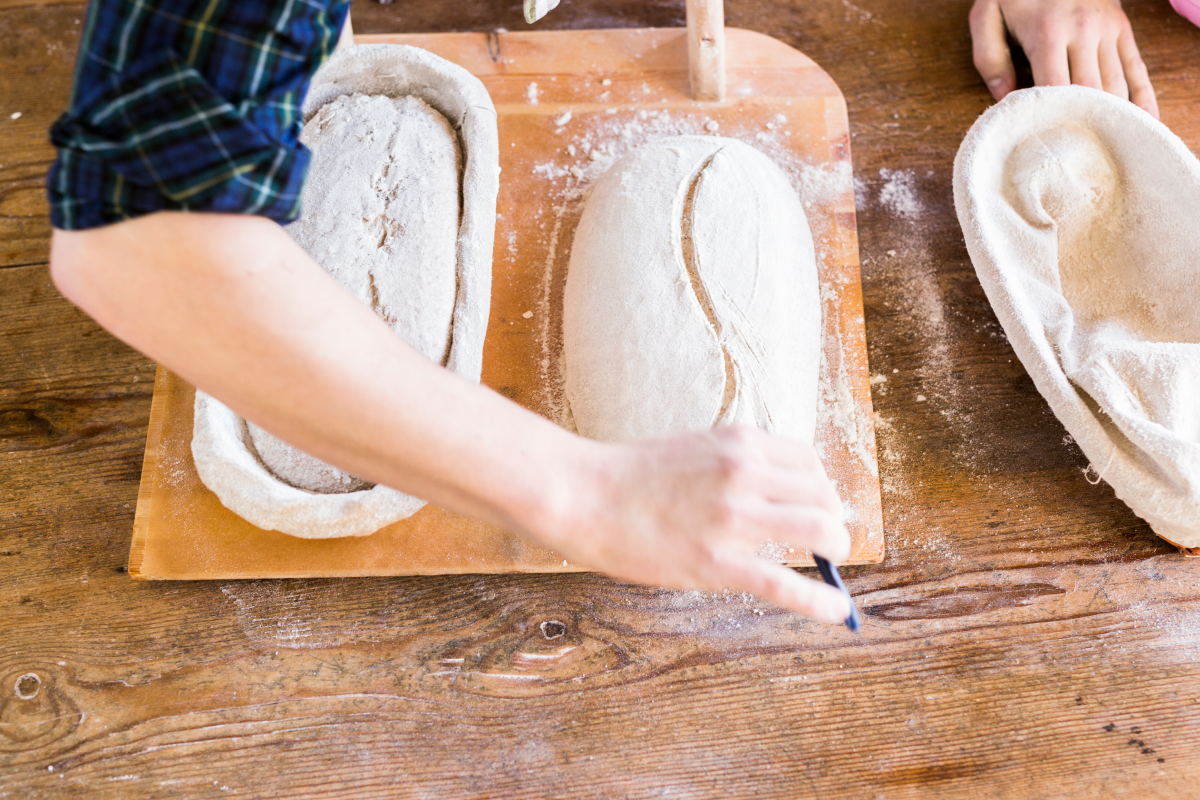
Refrigerator space for cold proof. Each shaped loaf in a banneton takes up about as much space as a large mixing bowl. If you're cold-proofing 4 loaves overnight, your fridge needs to clear 4 banneton-sized spaces. This is the most-overlooked logistics problem in batch sourdough.
Bake sale timing. Sourdough is best the day it's baked, second-best the day after. For a Saturday bake sale, mix Thursday morning, bulk ferment Thursday into Friday, shape and cold-proof Friday afternoon, bake Saturday morning. Don't try to bake everything Saturday morning from scratch — you'll be exhausted before the sale starts.
If you're newer to sourdough and want to start with the most forgiving recipe before you scale up, the no-knead sourdough bread recipe is the easiest place to begin — long fermentation does the structural work, so even a beginner can scale it confidently.
Adjusting for Different Starter Hydrations
Most home sourdough recipes assume your starter is at 100% hydration — equal parts flour and water by weight. That's the standard, and the calculator defaults to it.
But not every starter is 100%. Some bakers run a stiff starter (50–60% hydration) for slower, more consistent fermentation. Others run a liquid starter (110–125%) for very wet doughs. If your starter doesn't match the recipe's assumption, you need to adjust.
Quick math (where H = your starter's hydration percentage): A starter at hydration H% contains:
- Flour = starter weight ÷ (1 + H/100)
- Water = starter weight − flour
Examples:
- 100g of 100% starter = 50g flour + 50g water
- 100g of 50% starter (stiff) = 67g flour + 33g water
- 100g of 125% starter (liquid) = 44g flour + 56g water
The calculator handles this automatically — just adjust the starter hydration slider. But if you're doing it by hand, the formula above is the one to memorize.
When this matters most: If you're following a recipe that assumes 100% starter and you only have a stiff starter, you'll need to add extra water to compensate. Otherwise your dough will be drier than the recipe intended, and your final hydration will be a few points lower than the published number.
Adding Inclusions When Scaling
Inclusions are anything that's not flour, water, starter, or salt. Seeds, nuts, dried fruit, cheese, herbs, olives — anything you mix into the dough for flavor and texture.
The rule for scaling inclusions: they multiply by the same scale factor as everything else, but they're not counted in your hydration math. They're calculated as a percentage of total flour, not as part of the water-to-flour ratio.
A typical seed bread might use 10–15% seeds (so 50–75g of seeds for a 500g flour recipe). When you scale to 4 loaves, you scale the seeds along with everything else: 50g × 3.75 = 188g of seeds.
One caveat: wet inclusions (like olives in brine, or pre-soaked seeds) bring extra water with them. If you're using soaked seeds, drain them well — that surface water pushes your hydration up unintentionally. For accuracy at high inclusion percentages, weigh your inclusions before and after soaking and account for the difference.
Common inclusion percentages for reference:
| Inclusion | Typical % of flour |
|---|---|
| Mixed seeds | 10–15% |
| Cheddar cheese (cubed) | 15–25% |
| Fresh herbs | 1–2% |
| Olives (drained) | 15–20% |
| Dried cranberries | 15–20% |
| Walnuts (chopped) | 15–25% |
For scaling discard-based recipes (which use a different math entirely), the 25 sourdough discard recipes guide covers what to do with the leftover starter you'll inevitably have when you scale a sourdough recipe down.
Common Scaling Mistakes
A few things to watch out for when you start scaling recipes regularly.
Forgetting to weigh in grams. Cup measurements are fine for one loaf. They become unreliable past two. A cup of flour can vary by 30g depending on how packed it is — across 4 loaves, that's 120g of error, enough to drop your hydration by several percentage points.
Scaling salt the wrong direction. Salt percentage stays at 2% no matter how much dough you make. The calculator handles this, but if you're scaling by hand and your recipe says "1 teaspoon salt," do not just multiply teaspoons. Convert to grams first (1 teaspoon ≈ 6g salt), then scale.
Underestimating fermentation time. Larger dough masses can ferment slightly faster because they retain more heat from their own activity — but this also depends on container shape, surface area, and kitchen temperature. A 4-loaf bulk ferment in a deep narrow bowl behaves differently than the same dough spread across a wide shallow tub. Always watch the dough, not the clock.
Using a too-small bowl. Sourdough doubles or triples in size during bulk fermentation. A 6-quart bowl that's three-quarters full at the start will overflow by hour 8. Always size up.
Forgetting to scale shaping time. Shaping 1 loaf takes 5 minutes. Shaping 4 takes 20–25 minutes — and the first loaf you shape has 20 minutes longer to rest before the oven than the last. Either work fast, or stagger your shaping over a longer window and cold-proof to even things out.
Scaling baking time. Don't. Bake time stays the same. Each individual 900g loaf bakes for the same 45 minutes whether you're baking 1 or 6 — they bake one at a time (or two at a time in a Dutch oven setup), not all at once.
FAQ
Can I scale yeasted bread recipes the same way?
Yes — baker's percentages work for any bread, sourdough or yeasted. The only difference is that commercial yeast scales linearly without the "hidden water" problem starter has. So scaling yeasted bread is mathematically simpler.
What's the biggest sourdough batch I can do at home?
Most home kitchens max out around 6–8 loaves per bake day. The bottleneck is usually fridge space for cold-proofing, not ingredient mixing. Beyond 8 loaves, you're staggering bakes across two days.
Do I scale baking time too?
No. Each individual loaf bakes for its standard time regardless of how many you're making. Big loaves take longer than small loaves, but multiplying loaves does not multiply bake time.
My scaled recipe came out denser than the original. Why?
Most likely your bulk fermentation finished earlier than you expected — bigger dough masses ferment faster. Watch for the volume increase, not the clock. Also check that you scaled salt and starter together; bumping starter up but not salt will throw off the rise.
Can I scale down a recipe to less than one loaf?
Yes, but the calculator's minimum is 1 loaf at 100g (not very useful). For very small batches, just enter a custom loaf size — say, 300g — to get a single small boule.
Should I scale my starter feeding to match?
Not necessarily. You don't need a giant starter to bake giant batches — you only need enough starter to provide the amount called for in the recipe. For a 4-loaf bake calling for 375g of starter, build a starter that produces around 450g (so you have a little extra). You don't need to feed your everyday starter any bigger than usual.
My recipe is in cups. Can I still use the calculator?
The calculator works in grams only. To use a cup-based recipe, convert first: flour ≈ 125g per cup, water ≈ 236g per cup, starter (at 100% hydration) ≈ 220–240g per cup (varies by activity and consistency), salt ≈ 6g per teaspoon. Then enter the gram values into the calculator.
What if my recipe doesn't use exactly 2% salt?
That's fine. The calculator scales whatever percentage you enter, even if it's not the standard. Just enter your actual salt weight in grams, and the calculator will preserve your ratio at scale.
Final Thoughts
Sourdough scaling is one of those skills that feels intimidating until you do it once, then becomes second nature.
The numbers to remember:
- Flour is always 100%. Every other ingredient is a percentage of flour.
- Standard sourdough is 100/70/20/2. Flour, water, starter, salt.
- True hydration includes water from your starter — that's what trips up most calculators.
- Scale factor = target total dough ÷ original total dough. Multiply every ingredient by that number.
- Don't scale baking time. Each loaf bakes for its own time regardless of batch size.
For a beginner-friendly sourdough recipe to practice scaling on, my no-knead sourdough bread is the most forgiving place to start. For ideas on what to do with the inevitable extra starter you'll have after scaling down, the 25 sourdough discard recipes guide is a good rabbit hole. And if you want to use up active starter while you bake, my sourdough soft pretzels and sourdough cinnamon rolls are weekend favorites that pair with any sourdough bake day.
Once you have the math down, scaling becomes the easiest part of sourdough baking. The hard part is fermentation — and that's a different post entirely.
Related
Looking for other recipes like this? Try these:
Pin to Pinterest